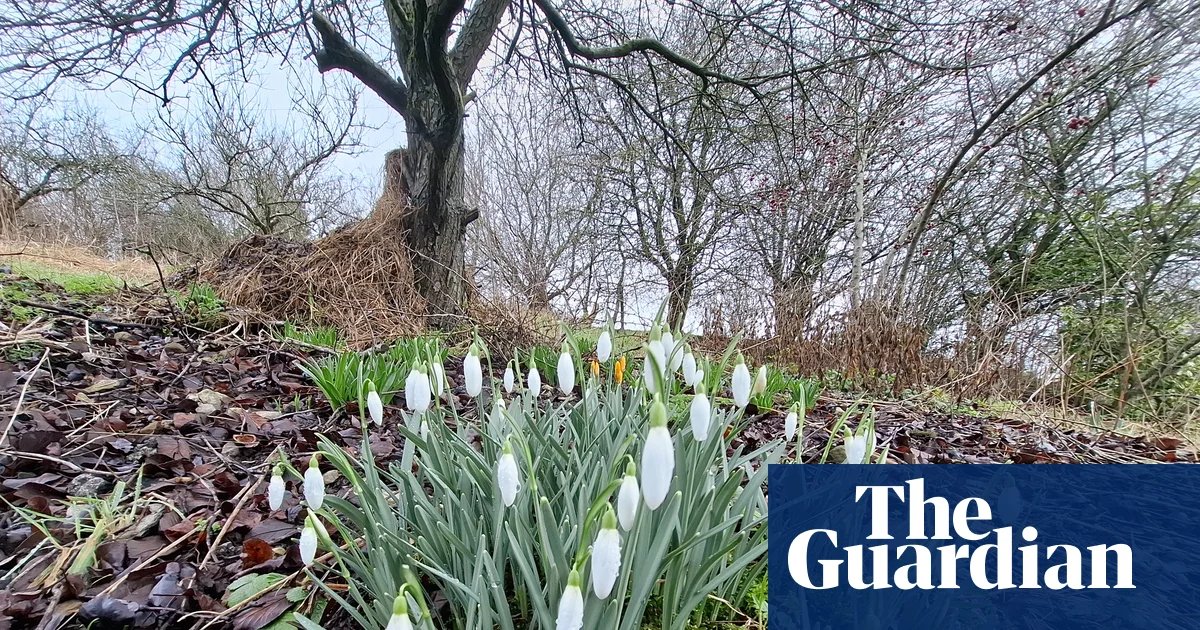
I wonder if nature has found a way to compensate us for the dreariest winter I can recall, because the snowdrops this year have been unbelievable. I’m seeing them everywhere – along road verges, on village greens, with vast white sheets across churchyards and especially in old gardens with driveways and mature trees around their margins.
I have a small snowdrop patch under our crab apple and while they’re modest in number, they are, in a way, more than flowers. My mother first planted those same bulbs (or their “parents”) in her garden, which is half a mile from here, in the 1970s. When she died a decade ago, I took them first to our old house and now to this property. I’d actually forgotten the last transfer: a scoop of both the bulbs and surrounding soil, a short car journey, then a hasty reinterment in a hole on this south-facing slope. Now here they all are, up in the light, sparkling and brimful of this seasonal moment, but also laden with memories of my wonderful Ma and her love of gardens. In a way, her snowdrops are now family.
Yet snowdrops are family in another genuine sense. I was reminded of this by Prof Robert Fosbury, a distinguished astrophysicist who researches the impacts of light upon eukaryotic life, which is essentially you and every other complex organism on Earth. We’re all deeply familiar with the idea that visible light drives photosynthesis, in turn making life possible at all. But Fosbury has discovered that light we cannot see, in the infrared spectrum – which can penetrate exposed surfaces and reach every cell in our bodies – is also crucially important.
Infrared light has been shown to have conditioning and essential healthful impacts upon our mitochondria, those organelles that oversee energy distribution within every one of our cells. If we’re not exposed to infrared light, which penetrates us even when it’s first intercepted by a tree canopy, then all mitochondria-bearing organisms – including snowdrops and the person who loves them – will lose condition. The flower and the human suffer alike because at root, we are all part of one enormous, ancient, light-created, light-requiring and light-loving family.