
You May Also Like

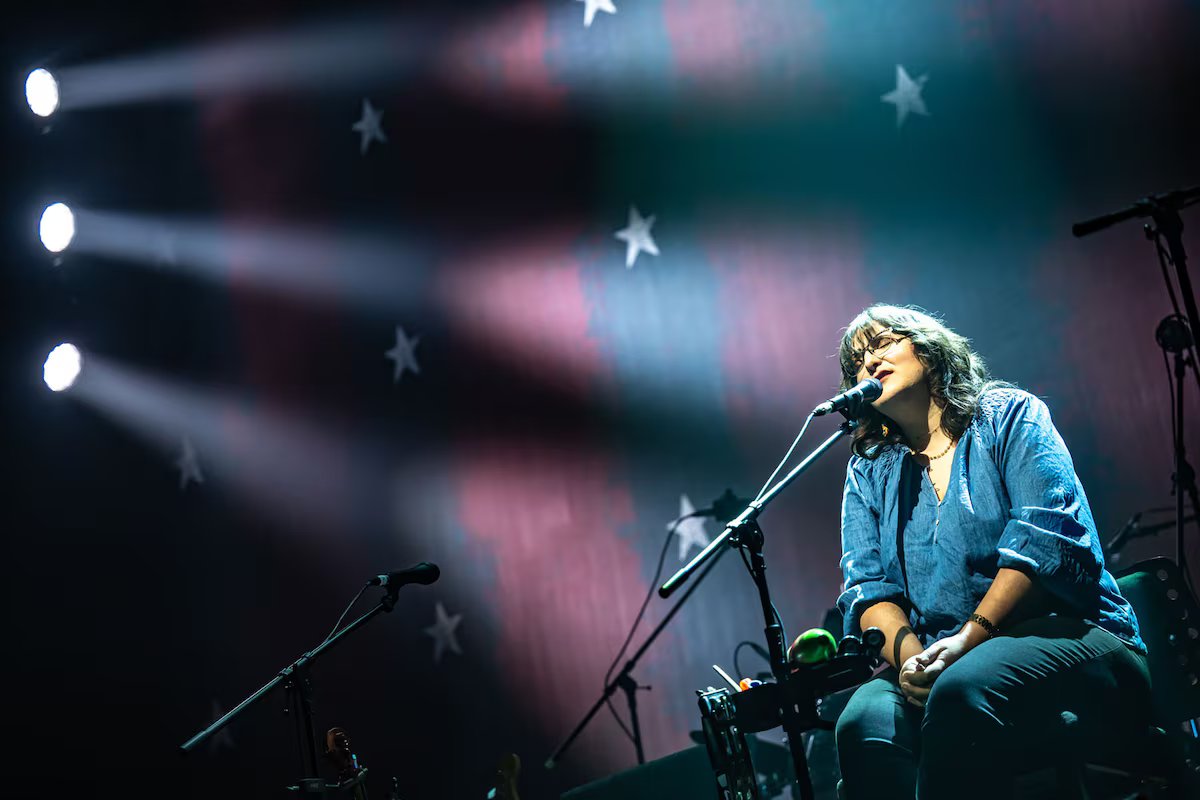
Brielle Ansems in Inside American Pie.Dahlia Katz/Supplied
On the 1972 album Meet the Brady Bunch, the television family sings a bizarre version of Don McLean’s American Pie. The chirpy tone of their rendition suggests they were oblivious to the notion that “helter skelter in a summer swelter” was most likely a reference to the Manson Family murders three years earlier.
The six kids probably weren’t hip to the irony of them singing “the day the music died” while cheerfully destroying a great pop song either.
Does all that matter? Mike Ross, co-creator with Sarah Wilson of the musical stage production Inside American Pie currently playing at Toronto’s CAA Theatre, doesn’t necessarily think so.
“When I was 12 years old, we had the cassette tape of American Pie and I would listen to it over and over again from the back seat of the car,” he says. “I would try to remember all the words, but I wasn’t trying to understand. I just liked it. And that was enough, you know?”
As an adult, however, Ross has devoted a good part of his career contextualizing pop music in the role of what might be called a melodic musicologist.
Mike Ross in Inside American Pie.Dahlia Katz/Supplied
Released in 1971, American Pie is a symbolically charged sing-along and tightly coded opus about the loss of innocence and the death of rock ’n’ roll. Its “day the music died” refers to Feb. 3, 1959, when a plane crash killed musicians Buddy Holly, Ritchie Valens and J. P. Richardson (the Big Bopper). The stage show, which Ross narrates, explores the eight-minute-plus folk-rock hit line by line.
McLean, a cranky troubadour, has always hated questions about the hummable yet enigmatic song’s meaning. He dislikes answers even more.
“People want to know more about the lyrics because they want to possess the feeling somehow more than just by hearing the song or hearing the words,” he told the Village Voice a year after American Pie’s release. “Once you possess something you immediately destroy the magic in it.”
But Ross, who is from Prince Edward Island, wants to deconstruct the song, not demystify it. With his band of PEI singer-musicians, he guides audiences through the six verses, adding historical context and offering clues.
In between the show’s thoughtful, relevant covers − Holly’s Everyday, John Lennon’s Imagine, Creedence Clearwater Revival’s Bad Moon Rising and more − Ross illuminates American Pie and an era. When he explained, for example, that “rye” could be whisky or might mean Rye, N.Y., the crowd at the show I attended reacted with “ah” in unison.
The cast of Inside American Pie.Dahlia Katz/Supplied
“You hear that discovery in the audience at different points every night,” he says.
We’re speaking in a boardroom at Mirvish Productions, the commercial theatre colossus that first brought Inside American Pie to Toronto in 2025. What Ross calls a “docu-concert” premiered in 2021 at Harmony House, a music hall the 50-year-old musician and his wife, Nicole Bellamy, own and operate in Hunter River, PEI.
Earlier this year, the production travelled to Curve Theatre in Leicester, England. The East Midlands Theatre website gave the production five stars out of five for a “joyous and emotional deep dive.”
While Ross created docu-concerts during his years at Toronto’s Soulpepper company, Inside American Pie was his first to zero in on a specific song. His second take on the concept, Inside The Wreck of the Edmund Fitzgerald, premiered at Harmony House last fall and sails into Toronto next year.
For Inside American Pie, Ross and Wilson developed a set list of songs that relate to American Pie’s lyrics and/or thematically exist in the same era. The choices are intuitive, but the arrangements and melodic alterations are often surprising.
Greg Gale in Inside American Pie.Dahlia Katz/Supplied
Lennon’s Imagine is reimagined in a different key and a changed chord structure, with a melodic quote from French composer Erik Satie added in as well.
The kazoos in Chantilly Lace were a practical accommodation. There are saxophones in the Big Bopper’s 1958 recording, but Ross doesn’t have a saxophonist in his band. The original John Fogerty-written Bad Moon Rising from 1969 bounces and choogles, but Ross felt foreboding lyrics such as “I see bad times today” could work in a dreamier musical setting.
Bob Dylan once told Rolling Stone magazine that he saw Holly and Valens at the Duluth Armory in Minnesota, three days before they died in an Iowa cornfield. Dylan is the “jester” referenced in American Pie. Where his The Times They Are A-Changin’ from 1964 is strummed and folky, Ross determined an edgier approach was required for his show.
“I wanted a style that was direct that expressed the danger of that song,” Ross says. “It’s a demand and it’s a last warning. The action of the story I am telling is the story of Bob Dylan as a truth-teller who is willing to sound the alarm when maybe nobody wanted to hear that alarm.”
McLean has not seen Inside American Pie, nor has he commented on it. Which is fine by Ross.
“I wouldn’t want the bubble of my interpretation of this work of his to be broken,” Ross says. “And I think that’s important, because, as I say in the show, however you interpret things, that’s up to you. That’s what great art offers, and I hold that close to me.”
Inside American Pie continues at Toronto’s CAA Theatre to May 3.
Editor’s note: This story has been updated to correct the name of Sarah Wilson, co-creator of Inside American Pie.


