

Two technologies, two cost profiles
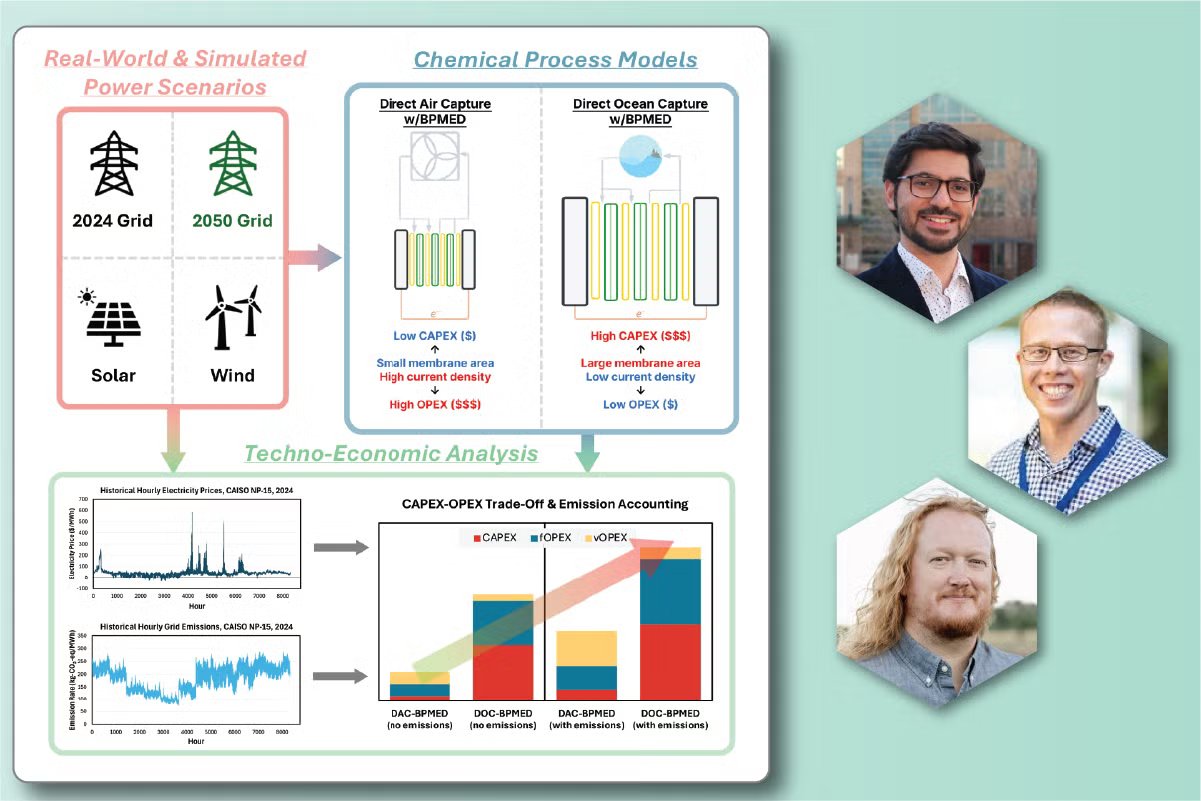
The comparative study revealed a foundational trade-off rooted in a fundamental difference between DAC and DOC: Concentration. Air contains about 120 times less carbon than seawater, requiring large volumes of air to be processed at every iteration. However, once the CO2 is captured via a liquid solvent, typically a hydroxide, the comparison reverses. A typical liter of DAC solution contains 0.5 to 1.0 moles of dissolved carbon, which is roughly 160 to 320 times higher than the dissolved carbon in a liter of seawater. That means a DAC plant needs to process far less liquid to recover a given amount of CO2 compared to DOC, but extracting carbon from such a concentrated solution requires running the BPMED part of the system at high intensity, at high electrical current, which consumes significant energy. The equipment footprint is relatively small, but the electricity bill is high.
DOC works the other way around. Because seawater holds less dissolved carbon compared to a DAC solution, a DOC plant must process vast amounts of seawater to recover the same amount of CO2. The models estimate that DOC-BPMED would need roughly 20 times more membrane area than the equivalent DAC-BPMED system, representing a significant upfront investment. On the other hand, the electrically driven process can run at a much lower current when handling dilute seawater, using considerably less energy per tonne of CO2 captured.
These differences are obvious in the cost estimates. For a plant capturing 100,000 tonnes of CO2 per year, and connected to the current California electricity grid, the modeled cost of capture via DAC-BPMED came in at around $470 per tonne of CO2 in the baseline case. For DOC-BPMED, the equivalent figure was around $1,500 per tonne, roughly three times higher. This is driven largely by the upfront cost of all the additional equipment, and not the energy use.
The authors are careful to state that these modeled estimates have a meaningful level of uncertainty built in, and they will shift as the underlying technologies mature. But the overall trends are clear. At present, and with the current equipment costs, DAC-BPMED has a significant cost advantage over DOC-BPMED under this electrically driven regeneration approach.