
Now Reading: ASU Health aims to promote proactive health care with artificial intelligence
- 01
ASU Health aims to promote proactive health care with artificial intelligence

ASU Health aims to promote proactive health care with artificial intelligence
AI to be significant component in ASU’s medical suites of the future

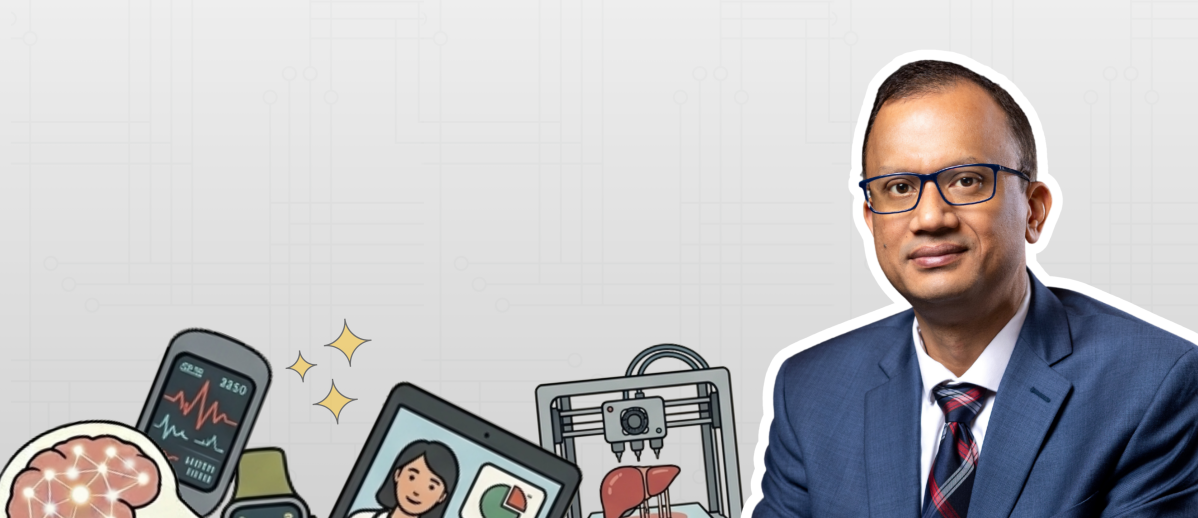
Graphic by Chad Musch/ASU
ASU Health has embarked on its mission to transform health care and create a new kind of health professional.
ASU Health includes four academic units — two of which are new to the university ecosystem. The John Shufeldt School of Medicine and Medical Engineering and the School of Technology for Public Health join the Edson College of Nursing and Health Innovation and the College of Health Solutions to form the educational foundation for ASU Health.
In addition, the Health Observatory builds on ASU’s existing relationship with Mayo Clinic to develop a better understanding of community health in Arizona, and the Medical Master’s Institute creates opportunities for health professionals and medical students to upskill in areas like pediatrics, gerontology, advanced nursing and nutrition.
In this fourth part of a five-part series, ASU talked to Jyoti Pathak, founding dean of the School of Technology for Public Health, about the role AI will play in health care.
Note: Answers have been edited for length and/or clarity.
Question: AI is going to be such a big part of ASU Health, so let’s start with an overview question. How would you describe the role AI is going to play?
Answer: That’s a big multibillion-dollar question. A couple of things come to mind. In general, when we think about health, health care, health care delivery and public health, we often work in a very reactive mode. Someone gets sick, we put them on drugs. Or someone just had a surgical procedure done, and we are waiting on them to see if they might get an infection and then act on it. So, it’s very reactionary, and we all know that prevention is always better than cure.
The question becomes, how can we make the overall system more proactive as opposed to being reactive? That’s where I think one potential role for AI is. Can we identify individuals who are at risk of getting diabetes, so you don’t have to put them on other kinds of drugs and think more of behavioral interventions, diet, exercise, nutrition, things like that.
Q: How would AI do that differently from having regular visits with a physician?
A: AI could do it through digital solutions, some of which could be more passive. For example, patients who are prediabetic could have a small patch, like cigarette smoking, a cessation patch that goes in your body and continuously monitors your glucose levels. The moment it sees any spike, it could alert the patient or the provider. Likewise, if someone is having suicidal thoughts and all of a sudden they’re not getting out of their house, they’re not getting exercise, they’re not being social — your cellphone could actually act as a proxy that could potentially send some signals.
Now, there are privacy concerns and ethical concerns, but a lot of the technology is slowly getting developed that would allow you to do that sort of remote monitoring and remote assessment without actually going to a doctor’s office.
Q: How else could AI be used?
A: Where we are seeing AI, not just in health but broadly in general, is to facilitate a lot of back-office things. For example, if someone is a cancer patient and they have to get certain types of cancer treatment, as an oncologist, frequently you would need to get preapproval from your insurance provider before someone could be administered $10,000 in chemotherapy. So, a lot of paperwork going back and forth and fax machines and emails. There can be a role for AI to automate some of those things.
The hope is that if these AI systems can take some of the administrative burden and responsibilities away, (doctors) can look into your eyes as opposed to looking at a computer.
Q: Let’s shift to ASU Health specifically. How do you envision AI being used in ASU Health?
A: Let’s say, for example, the Edson College of Nursing and Health Innovation. They are doing a project where an agentic AI nurse will accompany a physical nurse and help the nurse or the patient with whatever they’re doing. We are also training our students and teaching our students about the role of AI in the context of public health.
So, how would you simulate the outbreak of the next COVID 19? That requires digital simulation, that requires AI-based modeling of the phenomenon, in this case, the spread of the virus. And when it comes to the John Shufeldt School of Medicine and Medical Engineering, as they’re designing the curriculum, it’s highly intertwined with AI-based pedagogical courses in designing new risk-prediction models. It’s also thinking about clinical decision support, mobile labs and robotic surgery.
Q: The medical suites of the future will be on the ground floor of the ASU Health headquarters in downtown Phoenix and heavily intertwined with AI. In what ways?
A: It’s still a very evolving concept, but they certainly want to, for example, train students in how to become more adept with using AI technology when they’re diagnosing patients. And, when they’re having a patient encounter, how could technology be a companion? They’ll also be thinking about these AI tools which are FDA (Food and Drug Administration) approved. The FDA just approved an AI product that could be used for early detection of like 14 different conditions, like liver disease, cirrhosis, things like that. So, the medical suite of the future wants to engage with industry in co-designing and validating some of those solutions.
On the public health side, we are thinking about a social media influencer-type program, which is to train influencers to spread good information and not disinformation. There would be a role for AI technology in how you communicate, how you design your messaging, how you spread your messaging, and at the same time, how do you dissuade any sort of misinformation?
Q: Where will the intersection of AI and health care take us in 20 years?
A: That’s a great question. I’ll have to look at my Magic 8 Ball. My hope is that the technology becomes so mainstream that you don’t even have to think about it. That’s success in my mind. Then, No. 2 is that a lot of the action with AI is happening in the Western Hemisphere. But if we have to lift the entire planet, action needs to happen in the rest of the world.
So, how would AI technology adaptation and AI technology development look throughout the world where you might have a different set of constraints? You may not have robust internet connectivity. You may not even have robust electricity. You may not have widespread iPhone devices. How would you enable that global capacity and do such technology in a way that’s equitable and more ethical. I think those are kind of the big picture questions that the whole world needs to kind of start thinking about.
Learn more in our 5-part ASU Health series
By: Scott Bordow | March 20, 2026 | Original Post