
A recent Association of Washington Business survey found 44 percent of employers are considering moving their personal residence out of state, citing taxes and cost pressures.
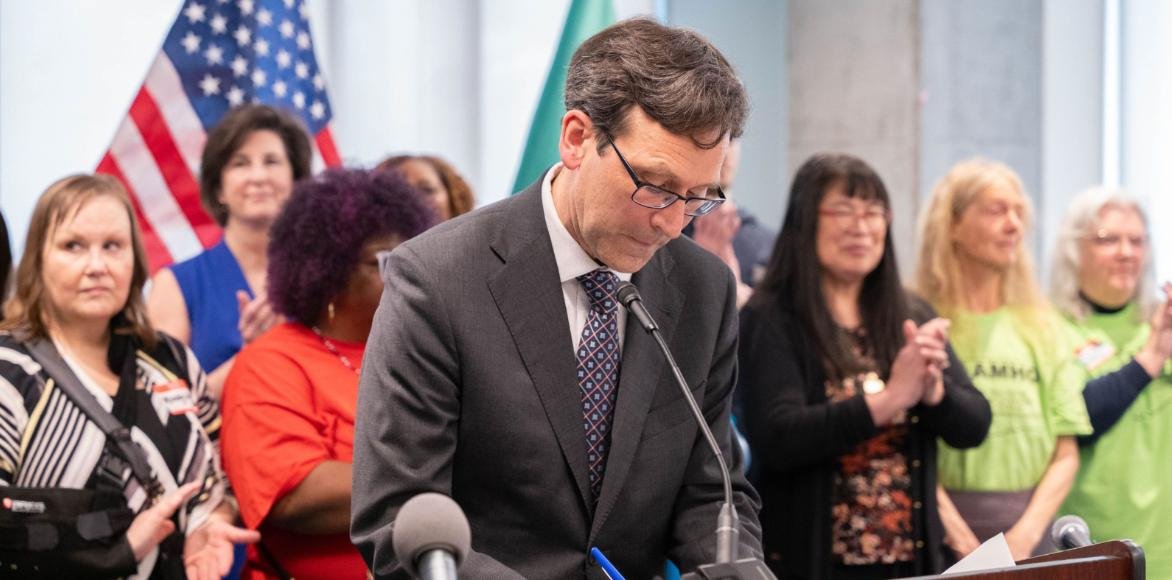
Washington Governor Bob Ferguson signed the Democrats’ controversial new state income tax into law Monday morning, establishing a 9.9 percent income tax on earnings above $1 million and igniting what is expected to be an immediate legal and political battle.
Ferguson signed Senate Bill 6346 at 10:00 am in Olympia, finalizing Democrats’ effort to implement an income tax in a state where voters have rejected similar proposals more than a dozen times. The measure passed without a single Republican vote.
Supporters say the tax will generate roughly $3.5 billion annually for government spending. Critics say it is unconstitutional and warn that the economic fallout may already be underway. Opponents argue that SB 6346 conflicts directly with Washington’s constitution, which has long been interpreted to require tax uniformity and treat income as property.
They also point to Initiative 2111, a voter-backed measure passed just two years ago banning income taxes, a law Democrats reversed this session without sending the question back to voters. Legal action is expected immediately. The Citizen Action Defense Fund announced before the signing that it would file suit immediately after Ferguson signed the bill. The litigation effort will be led by former Washington Attorney General Rob McKenna.
Republicans and critics have also raised alarms about how the bill was structured. Lawmakers included a “necessity clause,” blocking voters from filing a referendum to overturn the tax — despite the fact it does not take effect until 2028, with collections beginning in 2029. Critics say the move was designed to shut down the fastest path to a public vote.
While the tax won’t take effect for several years, there are growing indications that behavior is already changing. New data shows a 65 percent spike in luxury home listings immediately following the bill’s passage, with realtors reporting some high-end homeowners are listing properties in response to the tax.
Business leaders are also raising concerns. A recent Association of Washington Business survey found 44 percent of employers are considering moving their personal residence out of state, citing taxes and cost pressures.
Inside the tech sector, investors say the shift is already visible. “I’m seeing dozens… this has already happened,” venture capitalist Aviel Ginsberg told The Ari Hoffman Show on Talk Radio 570 KVI, referring to investors changing their domicile out of Washington.
Seattle entrepreneur Jesse Proudman echoed the trend, saying, “Everybody’s on their way out,” pointing to migration toward states like Texas and Florida.
The tax arrives as Washington’s economy shows signs of strain. The state’s unemployment rate has climbed to 4.7 percent, even as the national rate has declined. The increase comes amid layoffs at major employers, including Microsoft, Amazon, and Meta, with over 30,000 jobs cut in the region.
Seattle has also seen a wave of business challenges, including store closures, declining foot traffic, and corporate pullback. Starbucks is moving its corporate headquarters to Nashville, and the coffee giant’s founder, Howard Schultz, announced he moved to Florida the same day Democrats passed the controversial tax. The company has also shuttered locations in the city, while office vacancies remain among the highest in the country at over 33 percent.
Along with the concerns, opponents are mobilizing. Let’s Go Washington founder Brian Heywood, who led the initiative banning income taxes, is pushing for a repeal measure on the November 2026 ballot and preparing for a broader legal and political fight. “Stay and fight,” Heywood said, urging residents not to leave the state as opposition builds.
That fight is expected to play out on multiple fronts — in the courts, at the ballot box, and potentially in judicial elections that could determine how Washington’s constitution is interpreted.
Leave a Reply