
I can tell that the week ahead is going to be extra on the rare occasion when Substack gives me this message when I’m still accumulating rough notes about the topics I want to cover in this column:

I’ll try to keep it manageable—we can dig in deeper during the week, but I wanted to start by acknowledging that there’s a lot going on right now. Before we dig into the fallout from the Supreme Court’s Callais decision, which seems likely to dominate the week ahead, a little news from the kleptocracy front to follow this week. (To make things more interesting, my proofreader is unexpectedly out for the day, so please give me a little grace).
When Kristi Noem became the Secretary of DHS, we discussed her unusual housing arrangements. We’ve just learned in a letter from Democrat Robert Garcia, the ranking member of the House Oversight Committee, that she’s still living in the taxpayer-funded United States Coast Guard residence she booted the Commandant of the Coast Guard out of and took it over for herself after she was confirmed. That’s nearly two months after President Trump fired her. The residence is described as a “spacious waterfront residence” in Washington, D.C., on Joint Base Anacostia-Bolling. The grift never ends. Let your elected representatives know you don’t want to pay Noem’s rent any longer—in fact, she should be charged for every minute she overstayed the tenuous justification she had for being there in the first place.
Maurene Comey, daughter of former FBI Director Jim Comey and a formidable prosecutor in her own right—she charged Jeffrey Epstein and convicted Ghislaine Maxwell—gets to pursue a lawsuit of her own after a judge rejected the government’s motion to dismiss the case. We discussed her lawsuit here when it was filed. I noted that the case was “important because it will have an impact on Trump’s ability to fire at will in the federal bureaucracy, ignoring existing civil service protections for government employees, not just at DOJ, but likely closer to government wide.” That seems to have become the case in short order.
I flagged this new ruling for you last week. Now that I’ve had a chance to read the order, it seems that Trump has been hoisted on his own petard. We discussed how Comey was fired in the earlier piece:
“She wasn’t fired by her boss, the U.S. Attorney for the Southern District of New York, Jay Clayton. Instead, she received an email saying she was being terminated ‘[p]ursuant to Article II of the United States Constitution and the laws of the United States.’ In other words, by virtue of presidential power. As Trump put it during a Turning Point USA speech to young people during his first term in office in 2019, ‘I have an Article II, where I have the right to do whatever I want as president.’”
DOJ wanted to limit Comey to an administrative remedy—going to the Merit System Protection Board—which Trump has reshaped in a more conservative fashion by firing members (the irony!) without cause and replacing them with his own people. The government argued that she wasn’t entitled to sue in federal court. But the Judge determined that because the administration fired her using the president’s asserted Article II constitutional powers rather than civil service law, Comey could bring her claims before a federal judge. So too for everyone else Trump has fired pursuant to “his Article II.” Next stop, discovery, where the fun begins.
On Wednesday, Commerce Secretary Howard Lutnick is scheduled to sit for a voluntary transcribed interview with the House Oversight Committee. The topic is his past ties to Jeffrey Epstein. Lutnick has acknowledged visiting Epstein’s private island in 2012 with his wife, kids, and nannies, and meeting him on other occasions. That contradicts his earlier statement that he and his wife were so disgusted after a visit to Epstein’s Manhattan home that he severed ties in 2005. Lutnick has declined to explain the apparent lie, saying he’d agreed to the hearing this week and would do that then. The time has come. I’ll be watching.
On Thursday, the Southern Poverty Law Center will be in court for arraignment, where they will have the opportunity to plead “not guilty.” In the meantime, they’ve filed a motion to “TO ADDRESS THE GOVERNMENT’S MATERIALLY FALSE STATEMENTS AND TO ENFORCE RULES PROHIBITING FURTHER PREJUDICIAL EXTRAJUDICIAL STATEMENTS,” which you can read here. These folks are experienced litigators, and they understand the game DOJ is trying to play.
A motion, when done properly, contains a table of contents that give the reader a good outline of what the party’s argument is. This one is done exceptionally well, and the table gives us the gist of the point SPLC wants to make here:
-
The defense provided information to the U.S. Attorney’s Office shortly before the indictment, establishing that the SPLC had shared information from informants with law enforcement
-
DOJ indicted the SPLC and immediately made press statements.
-
The defense promptly notified the prosecution that Acting Attorney General Blanche had made a false statement and explained why the statement was false
-
Prior to filing this motion, the defense asked the government to correct its false statement to avoid the need for court intervention
The motion goes on to explain, correctly, that prosecutors have an obligation to ensure they don’t make false statements and to correct any that are made. And beyond that, DOJ prohibits its prosecutors from making public statements that jeopardize a defendant’s right to a fair trial. Given what SPLC calls the “government’s media blitz in the days since the indictment was returned,” they ask the court to address this situation. “The false and misleading statements at issue here are sufficiently egregious to merit Court intervention. The Rules of Professional Conduct are the minimum standards for a lawyer’s conduct, and this Court should exercise its supervisory powers to rectify the harm that the government has refused to self-correct. Within three hours of announcing the indictment of the SPLC, Acting Attorney General Blanche made a demonstrably false and misleading statement to an audience of millions about the SPLC’s provision of information to law enforcement, prejudicing the SPLC.” The motion contains a detailed listing of prejudicial statements, including some involving the president.
The defense asks the judge to order DOJ to correct the false claims and direct them to refrain from additional comments in this vein. “This kind of conduct has no place in the administration of justice and should not be permitted or rewarded with inaction. The defense respectfully requests that this Court take some form of remedial action to minimize external influence on potential jurors, to protect the SPLC’s right to a fair trial, to deter further misconduct and to protect the integrity of the federal court.” Although courts do have the power to act and SPLC cites one 11th Circuit case where some action was taken, the court isn’t obligated to do so; it’s a matter of where the judge’s sense of propriety is, so this will be an early test for Trump appointee Emily Marks, and may give us some sense of how she intends to conduct the case.
And, in the Jim Comey case, the acting Attorney General, Todd Blanche, went on Meet the Press Sunday morning. He told NBC’s Kristen Welker that individuals selling 86 merchandise or posting messages similar to Comey’s seashell post will not be prosecuted. “Of course not,” Blanche said. “That’s posted constantly. That phrase is used constantly.” He seems to be suggesting that the government has more than just the Instagram post—although that’s all that Comey is charged with. You’d expect that if there was something stronger, a threat contained in an email, for instance, the government would have charged it.
Welker: “How does that image of seashells amount to a serious threat against the president’s life?”
Blanche: “Rest assured that the career assistant U.S. attorneys in North Carolina, the career FBI agents, the career Secret Service agents that investigated this didn’t just look at the Instagram post and walk away…It’s not just the Instagram post that leads somebody to get indicted.”
It’s easy enough to suggest you have smoking gun evidence, but the government will have to share it with Comey in short order in the discovery process, which obligates them to turn over his own statements as well as the evidence prosecutors intend to use to prove his guilt. Trial by surprise isn’t permitted in our system. If the government has evidence that is stronger than what is in their speaking indictment, fair enough, but Blanche, in essence, is just saying “trust me,” we have better evidence than what we’ve revealed so far. And “trust me” no longer works with the Justice Department Blanche leads.
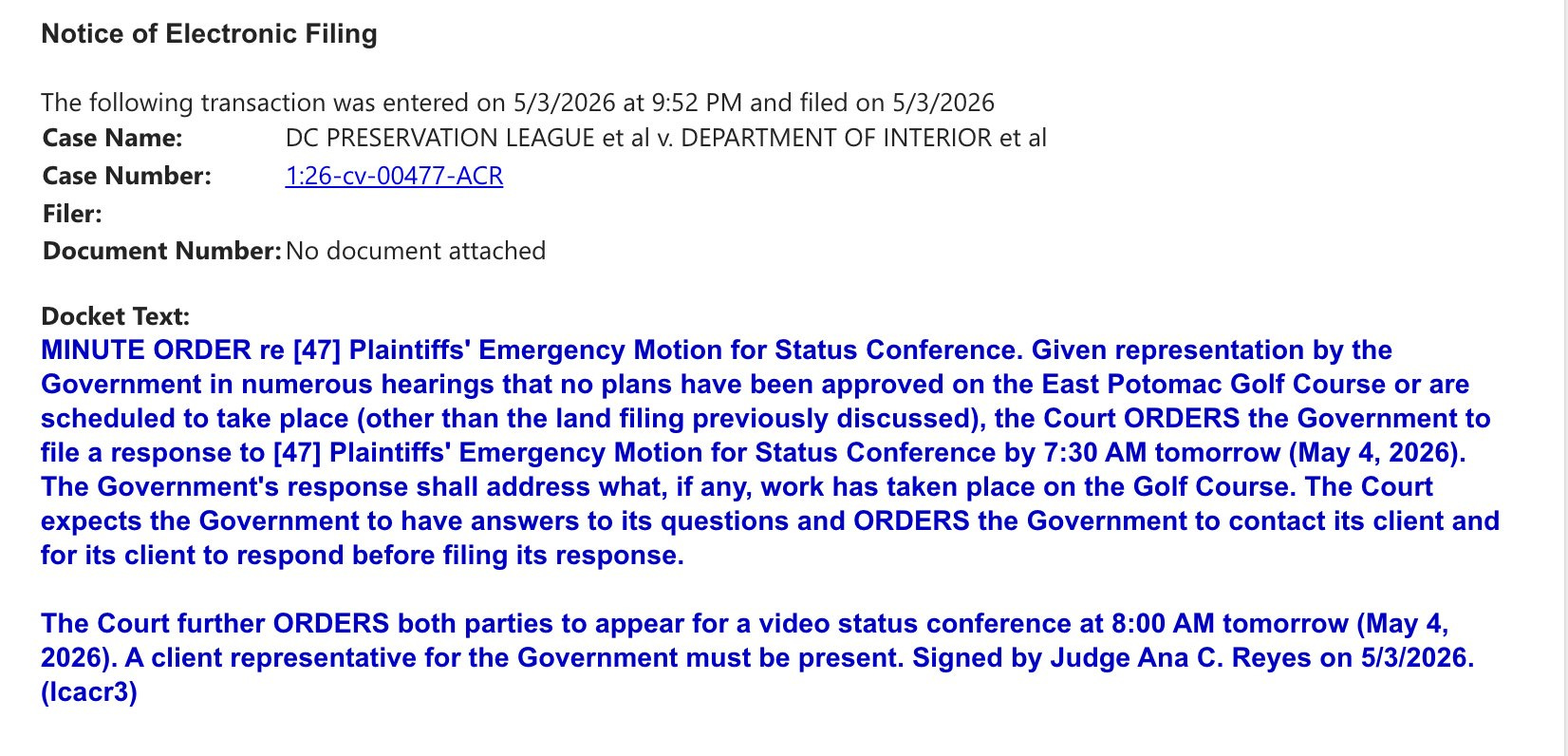
There is also a little late-breaking news. Even though it’s Sunday, lawyers were busy trying to block Trump from what they allege is an imminent takeover of East Potomac Golf Course. Trump, in what appears to be quite the conflict of interest given his personal ownership of multiple golf course has been pursuing the redevelopment of a major public golf course in the D.C. area, and perhaps others.
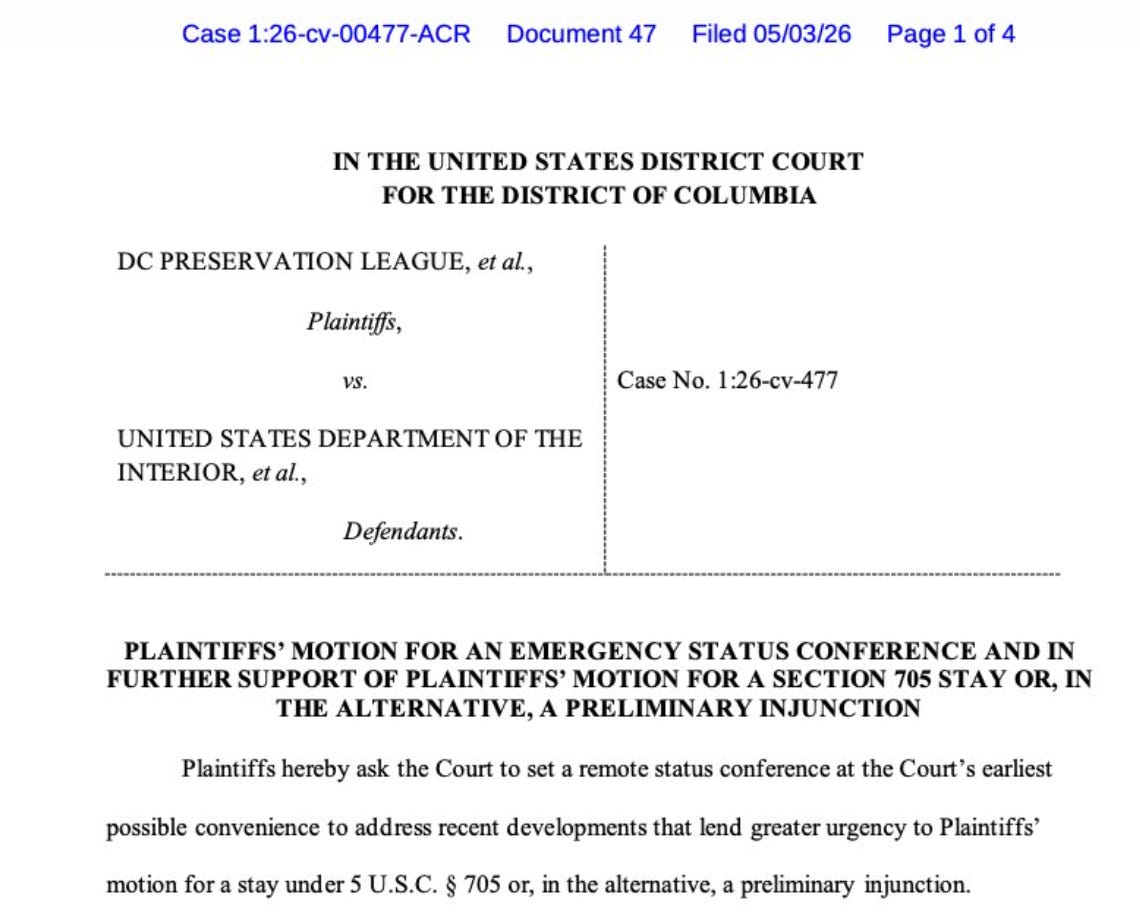
The judge took immediate action here, based on the information the plaintiffs put in front of the court. Judge Ana Reyes has ordered the administration to respond to allegations that, despite its prior representations to the contrary, work is underway on the East Potomac Golf Course. She has ordered them to file their written response by 7:30 am Monday morning and she has set a hearing for 8 am. That sounds like a judge who is inclined to believe the evidence the plaintiffs have offered.
Now, on to gerrymandering and voting rights, the fallout from Callais. The desecration of the Voting Rights Act will affect all of us, but the most important point is that there is actually something we can all do about it, and we must. Republicans will try to make us think it’s hopeless. They’ll insinuate Democrats should just stay home and not even bother to vote. But that’s not the case. Gerrymanders can be defeated by massive voter turnout. That’s our path forward; think Hungary. And remember that gerrymandering only affects races where we vote in districts, not statewide races.
I made a TikTok video to try and explain this, if you want to share it with your people.
There has been an outbreak of Jim Crowism across southern states, with many Republicans abandoning any sense of fair play and openly suggesting total Republican control of states, counting out Black voters and non-Black Democrats who vote with them. Like in Louisiana, where Democrats are 36.5% of registered voters, and Independents another 27.9%.
As we discussed, by the end of last week, Florida lawmakers passed a gerrymander they had begun work on before Callais was decided, rushing it through on the day the case came down. They hope it will give the GOP four extra seats in Congress. Louisiana officials put a stop to Congressional primary voting, nullifying early absentee votes that had already been cast so they can draw up new maps designed to end Black representation in Congress. Despite early comments from Governor Ivey to the contrary, Alabama will go to a special session to change the date for its primaries, which are set for May 19. They plan to ask the Supreme Court to permit them to get out from under its decision in Allen v. Milligan, which created a second Black opportunity district in the state in 2023. Tennessee’s governor announced a special session to redraw that state’s map, dividing up majority Black cities like a pizza being cut into uneven, irregular slices. And a push is underway in South Carolina, where there is only one Black opportunity district, the seat currently held by legendary Congressman James Clyburn, to persuade the government to call a special session to put an end to even that modicum of representation.
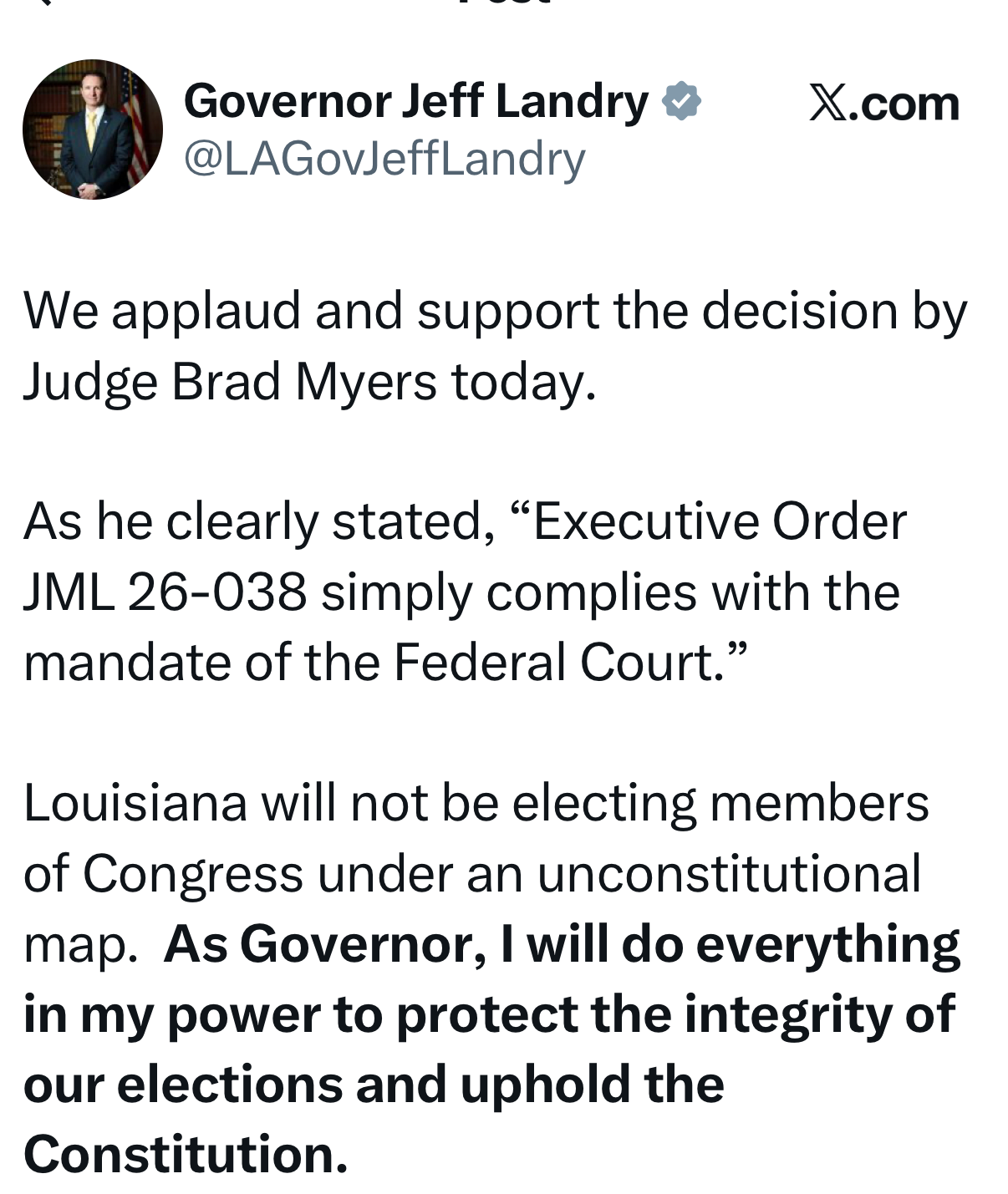
Louisiana Governor Jeff Landry had this to say, which makes one wonder: what happened to the Purcell principle, which Republicans have long been successful in getting the Supreme Court to rely on to avoid changes too close to an election? Landry called a halt to his state’s primaries after they were underway.
Expect lawsuits. Some have already been filed, like in Louisiana. Marc Elias will join us for a Substack Live on Tuesday to discuss that case and others. This is going to be quite a week.
Fair Fight’s Lauren Groh-Wargo struck a note of optimism that echoes my own thoughts, that massive voter turnout is the key to pushing back, in an essay about fighting back:
“We must leverage this attempt at massive voter suppression to drive the most robust, organized, and empowered mobilization effort in modern history this fall and fight attempts to steal or undermine the count and the results. Leaders in the South are already gearing up to do that. Allies everywhere must support this effort — and themselves turn out in record numbers. From Birmingham to Selma to Minneapolis, overreach has historically prompted voter backlash, and we must channel that here.”
If you’re reading Civil Discourse, you are almost certainly already registered to vote. That means you know how it’s done. Encourage people who aren’t already registered and help them get it done. And then inspire them, as well as people you know who are registered, but don’t always vote, to take this election seriously. It’s going to take all of us, but we can absolutely do it.
We’re in this together,
Joyce