
You May Also Like


The critiques of our analysis from the sustainable aviation fuel industry are inaccurate.
In late February, my co-authors and I blogged about a new tax credit for sustainable aviation fuel (SAF) that California Governor Gavin Newsom has proposed as a trailer bill to the 2026-27 state budget. It would allow refineries and other companies that pay diesel taxes in California to reduce their tax bill if they also produce sustainable aviation fuel.
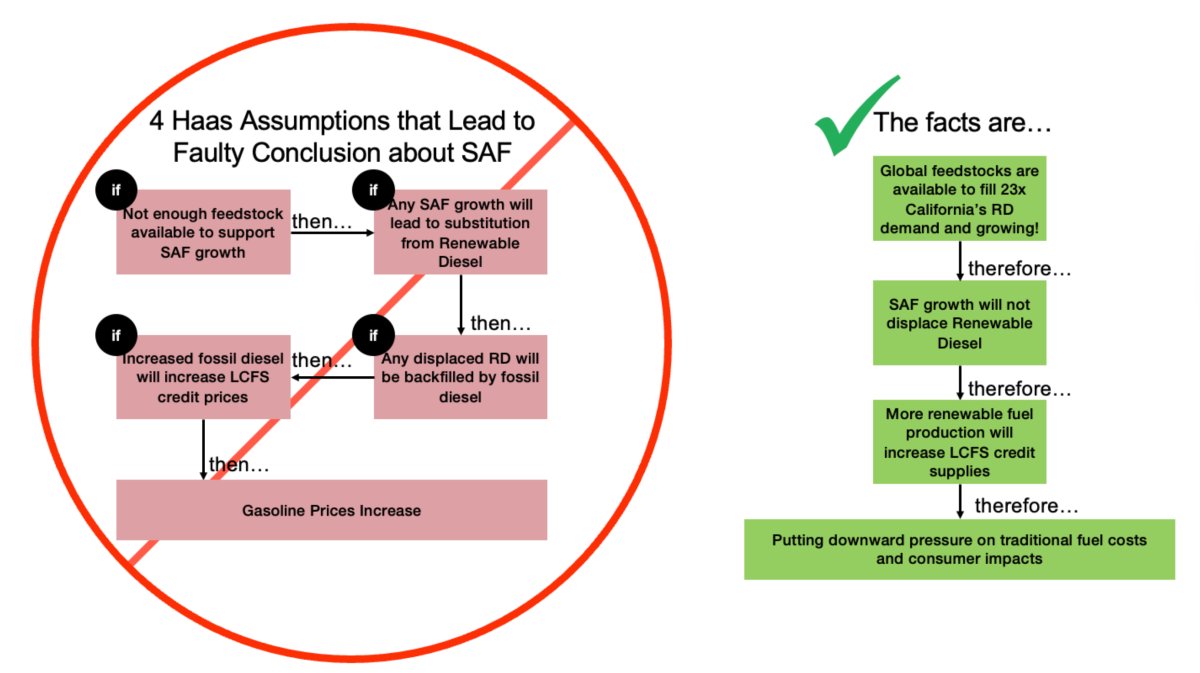
We argued that the proposed tax credit would reduce road funding, raise gasoline and diesel prices, and deliver small and expensive carbon emissions reductions. The Sustainable Aviation Advisory Council posted a response to our article entitled “Six Faulty Assumptions and Facts about California’s Proposed SAF Credit”. They included the graphic below to illustrate their arguments.

Here, I explain that the council’s points are incorrect. I quote each of their six claims about our assumptions and follow each one with my response.
First Claim
Assumption #1: “The SAF credit will significantly raise gasoline prices.”
Fact: This is inaccurate. This conclusion relies on a model that assumes renewable fuel producers are maxed out to full capacity, and if a facility were to produce more SAF, they would produce less renewable diesel. This is not correct. In reality, U.S. renewable fuel producers are running 40% under capacity. They have room to increase production of renewable fuels, which in turn will put downward pressure on Low Carbon Fuel Standard (LCFS) prices. Additionally, displacing fossil aviation fuel with SAF frees up refinery and market capacity to increase gasoline supplies, putting downward pressure on gasoline prices.
We do not assume renewable fuel producers are “maxed out to full capacity”.
Let me explain. Producing more SAF leads to less renewable diesel because of two facts.
Fact 1: both renewable diesel and SAF are $2-$5 per gallon more expensive to produce than their fossil counterparts. Therefore, they need substantial subsidies to be cost competitive, otherwise they will not be produced.
Fact 2: the federal renewable fuel standard (RFS) requires that a minimum quantity of biomass-based diesel fuels be used in the United States each year. SAF counts as biomass-based diesel in the RFS. If the industry produces more biomass-based diesel than required, then the RFS subsidies will disappear. It has no incentive to go above the mandate because of the first fact. Therefore, more SAF means less renewable diesel in aggregate.
Imagine a person who has to drink at least a gallon of a medicine she doesn’t like. There are two types of medicine, and she can drink any amount of either type as long as she drinks at least a gallon in total. If you pay her to drink some of type A, then she will drink less of type B because she dislikes them both and will not drink more than she has to. In the fuels context, a tax credit that incentivizes more SAF will lead to less renewable diesel.
Second Claim
Assumption #2: “There is not enough feedstock to support both renewable diesel and SAF production.”
Fact: This is incorrect. This is the same argument that was used in 2022, before several new renewable fuel production facilities came online (mostly in California) and almost doubled US production capacity. According to the Advanced Biofuels Association, the global supply of eligible feedstock is currently over 5.9 million barrels per day (90 billion gallons) – almost 23 times the diesel demand of California. The global collections rates of used cooking oil are less than 10%, so the availability of renewable feedstocks will likely continue to increase as long as economic incentives remain stable.
We do not assume that “there is not enough feedstock”. In a market-based system, whether there is “enough” of something depends on the price. If there is not enough of something, then the price increases to encourage companies to produce more and consumers to use less. We assume that if a refiner wants to use more vegetable oils or animal fats, then it has to offer a higher price than alternative users of the feedstock. We place no constraint on the amount of available feedstock.
It is true that enough feedstock exists in the world to produce approximately 23 times the diesel demand of California, but most of this feedstock is destined for the food system. About 20% of the calories consumed by Americans come from vegetable oils and fats. If we want to use more vegetable oils and fats for biofuel, then we need to convince consumers to eat less and farmers to produce more, and the only way to do that in a market system is for the price to increase.
I hope it is true that used cooking oil collections can increase without raising prices. And if this were to happen, using these additional feedstocks for renewable diesel rather than SAF would be less expensive and have a similar climate benefit.
Technical point: We assume in our model that the elasticity of net supply of waste oils and fats equals 2, i.e., a 1% increase in price causes a 2% increase in supply. Data on the supply of waste oils and fats are scarce. We chose a value of 2 by weighing industry claims that substantial amounts of these products could be acquired without raising costs much (high waste-oils elasticity) against the fact that the use of soybean oil and other non-waste feedstocks in biofuel has grown substantially in recent years (low waste-oils elasticity).
Increasing this elasticity a little would moderate the gasoline and diesel increases stemming from the tax credit because it would be less expensive to acquire the additional feedstock needed to meet the requirements of the RFS and LCFS while also taking advantage of the SAF tax credit.
Increasing the elasticity a lot would flip the balance for multiple different fuels that operate in the tangled web of state and federal biofuel policies. For example, we ran our model with an elasticity of 10 instead of 2. Without the proposed California SAF tax credit, this higher elasticity causes relatively more renewable diesel from waste oils and fats to be used in California (which would benefit the Phillips 66 refinery in California that currently produces renewable diesel mostly from waste oils and fats). If the proposed SAF tax credit were implemented, then even more renewable diesel would switch to SAF than in our baseline model, i.e., the state would lose even more diesel excise tax revenues than in our baseline model. Details at the end of this post.
Third Claim
Assumption #3: “Renewable diesel refineries can easily switch to producing SAF.”
Fact: This is false. Producing jet-quality renewable fuels requires tighter process control and additional refinery investment. Converting a facility optimized for renewable diesel into SAF production is neither automatic nor inexpensive, which limits the large-scale diversion assumed in the Haas and LAO analyses.
We do not assume that “renewable diesel refineries can easily switch to producing SAF.” At least six refineries in the United States are currently equipped to produce SAF from vegetable oils or animal fats. In May 2025, EIA reported that these refineries could produce 460 million gallons of SAF per year. Farmdocdaily published a larger number, estimating 834 million gallons of existing SAF capacity in 2025 and 2026. Our model of the proposed SAF tax credit projects between 200 and 370 million gallons of SAF from vegetable oils and animal fats, which could be produced using current capacity without any facilities needing to convert to SAF.
In addition, we project 90-570 million gallons of SAF from alcohol-to-jet (ATJ), which involves refining ethanol or isobutanol made from corn or sugarcane into jet fuel. Although cost estimates vary, this production process is widely understood to be more expensive and nascent relative to HEFA SAF. LanzaJet owns the only ATJ plant currently operating in the United States.
Fourth Claim
Assumption #4: “SAF policies don’t meaningfully reduce emissions.”
Fact: This is incorrect. In fact, SAF has the highest ROI for addressing climate goals in the aviation sector by immediately reducing lifecycle carbon emissions, particulate matter, and other harmful greenhouse gases, without requiring new infrastructure. It benefits local air quality leading to health benefits for vulnerable communities. Additionally, there are no good options to decarbonize aviation. Batteries are too heavy for long-haul aircraft and hydrogen faces major infrastructure challenges. Sustainable aviation fuel is the only scalable pathway to reduce aviation emissions over the coming decades.
Our recent research paper finds that the average cost of reducing carbon emissions with current biofuel policies is around $461 per ton of CO2, which is more than twice the social cost of carbon. Our analysis of the proposed California SAF tax credit finds that the incremental emissions reductions would cost $997-$2768 per ton of CO2, depending on the viability of making SAF from ethanol.
This tax credit proposal gives low bang for the buck because it mostly incentivizes switching from renewable diesel to SAF. We are already getting the carbon gains from using renewable diesel, so switching to SAF doesn’t help much.
Fifth Claim
Assumption #5: “The SAF credit would cost the state more than $1 billion per year.”
Fact: The estimate from the LAO report assumes far more SAF production capacity (834 million gallons) than currently exists in the U.S. (460 million gallons) and further assumes rapid conversion of RD refineries (see Assumption #3). When realistic production and logistics constraints are considered, the potential fiscal exposure to California’s budget appears substantially lower.
See my response to the third claim above.
Sixth Claim
Assumption #6: “California can’t reduce global GHG emissions by acting alone.”
Fact: Nearly every climate policy implemented at the state level faces some degree of market and emissions “leakage”. California’s clean fuel policies – like LCFS and cap-and-trade – operate within a global energy system and yet still have successfully driven the expansion of overall low-carbon fuel supply. Despite its small contributions to reducing global GHGs, California’s leadership on decarbonization has already created real-world impacts on markets and technologies at a global scale.
I agree that decarbonizing aviation is important in the long term, but I am skeptical that incentivizing SAF in California will meaningfully accelerate that process. SAF produced from vegetable oils and animal fats is a relatively mature technology with little scope for large cost reductions.
SAF producers need to buy 9 pounds of vegetable oils or animal fats at 50-70 cents per pound to make a gallon of SAF. On top of the feedstock cost, our model assumes an additional $1.63 of production costs. Even if process efficiency gains were to reduce production costs by a dollar, SAF would still be twice the price of fossil jet fuel.

Conclusion
I stand by our three projected outcomes:
- The proposed tax credit will incentivize much more SAF than projected by the administration.
- That increase in SAF comes at a cost: diesel excise tax revenues decrease by at least 20% and as much as 75% within a few years, and the prices of gasoline and diesel increase by 10-15 cents because of interactions with existing policies (or more or less with different elasticity assumptions).
- Because the SAF largely would come from diverting biofuels from surface transport to aviation, the net reductions in carbon emissions would be small and expensive.
The company best placed to immediately benefit from the proposed tax credit is Phillips 66, a Texas oil company that converted its oil refinery in Rodeo California to make renewable diesel and SAF mostly from waste oils and fats. If the objective of the proposed tax credit is to provide financial assistance to Phillips 66, then I encourage the legislature to explore ways to subsidize that company directly, rather than risking potentially large unintended consequences for California drivers and taxpayers.
We only have so many resources to spend on climate change mitigation — choosing expensive policies to reduce emissions means we are choosing to reduce emissions less than we could with more efficient policies.
In the last month, I have had two zoom meetings with representatives of Phillips 66 and the Sustainable Aviation Advisory Council in which I listened to their arguments and shared my responses. As of the time of writing, they have not corrected their “six faulty assumptions and facts” post. If they make a correction in the future, then I will note that fact here.
Addendum: Model Results Using a More Elastic Supply of Waste Oils and Fats
In a recent working paper, we developed a detailed model of US state and federal biofuel policies. A couple of weeks ago, we added the proposed CA tax credit to the model. Recently, we made one additional change to our model and re-ran it: we increased the supply elasticity of waste oil and fat feedstocks from 2 to 10 to illustrate what would happen if these feedstocks were to be much more available than we assumed.
The model parameters are calibrated to match 2018-2023 data and the model projects outcomes in 2030. When there is no SAF tax credit, a high elasticity means more waste oils and fats used in renewable diesel production in 2030. These feedstocks make almost three quarters of California renewable diesel up from one quarter in the baseline scenario. This outcome would benefit companies such as Phillips 66 that produce renewable diesel mostly from waste oils and fats. There is no SAF used in California in this scenario because it is too expensive relative to renewable diesel.

When the proposed California SAF tax credit is introduced, the model projects 1.8 billion gallons of SAF, enough to eliminate all diesel tax revenues. There is a correspondingly large reduction in renewable diesel. This quantity of SAF exceeds current production capacity and so would require more SAF capacity to be built, which may not happen in reality as quickly as it does in our model. However, the point remains that the proposed SAF tax credit, when coupled with an elastic supply of waste oils and fats, creates a huge incentive for SAF expansion.
A more elastic waste feedstock supply lowers biofuel costs in the absence of the SAF tax credit. The wholesale price of gasoline (i.e., the price before adding excise taxes and retail markups) is $2.40 compared to $2.54 in our baseline. Adding the SAF tax credit increases the gasoline price to $2.69. When the tax credit is in place, the price of gasoline is similar across the two elasticity scenarios. The price pattern is broadly similar for diesel.
Because of the complexity of state and federal biofuel policy, different elasticity assumptions will change the magnitude of the price effects. However, the main point does not change: the proposed SAF tax credit would cause substitution from renewable diesel to SAF and increase consumer fuel prices.

Follow us on Bluesky, LinkedIn, and our new Instagram. Also subscribe to our email list to keep up with future content and announcements.
Suggested citation: Smith, Aaron. “California’s Proposed SAF Tax Credit Really Will Raise Gas and Diesel Prices While Delivering Small Carbon Reductions ” Energy Institute Blog, April 20, 2026,
