

Now Reading: ‘Extraordinary discovery’ at Orkney’s Ness of Brodgar Neolithic site
- 01
‘Extraordinary discovery’ at Orkney’s Ness of Brodgar Neolithic site

‘Extraordinary discovery’ at Orkney’s Ness of Brodgar Neolithic site

 Scott Pike
Archaeologists are to resume digging at the Ness of Brodgar on Orkney after 3D radar technology led to an “extraordinary discovery”.
The dig team at the Ness, one of the most important Neolithic sites in the British Isles, are not revealing what they believe the find to be until more work is done.
But they say it is like nothing else ever found at the site – and may not even be Neolithic.
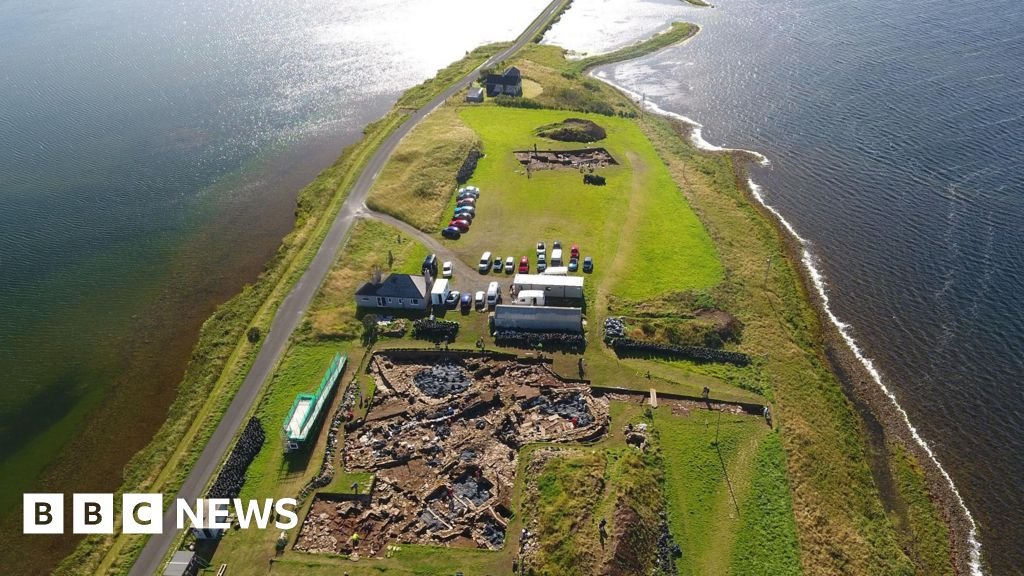
The Ness of Brodgar – a strip of land between two lochs – was the scene of 20 years of excavations until work officially ended in 2024.
 Hugo Anderson Whymark
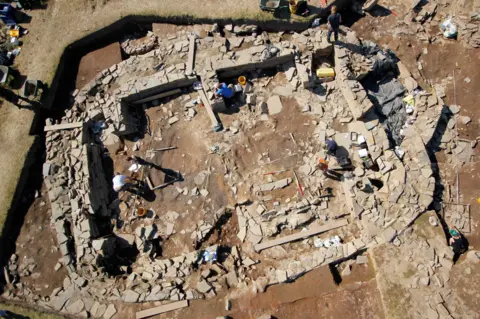
The digs uncovered 40 structures making up a cluster of buildings which showed it was a significant settlement in prehistoric Orkney.
However, a further phase of work using Ground Penetrating Radar (GPR) was carried out this summer – producing three-dimensional images of the whole site for the first time.
The scientific study produced an unexpected discovery which the team describe as “totally dissimilar to anything else we’ve uncovered”.
The only clue from the excavation team is that Ness is “a site that can be seen to be defined by straight lines and rectangular forms, from the architecture down to the art”.
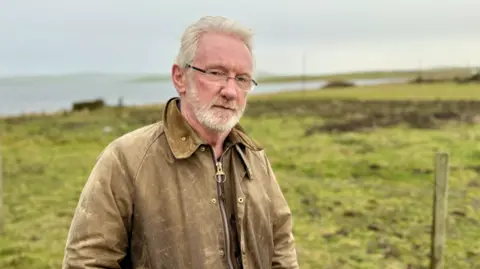
Archaeologist Nick Card – who worked on the digs from 2004 and will return for the latest work – told the BBC’s Radio Scotland Breakfast programme: “We think this is so unusual that it could add a new chapter to the history of the Ness.
“It’s at a bit of the site where there doesn’t seem to be any deep archaeology, so it’s not like we’re getting into another 20 years of excavations.
“The archaeology that will be uncovered will be quite different. Don’t expect three-dimensional Neolithic buildings. Possibly it is not Neolithic, I think probably later, but it could be contemporary.”
The Ness lies just south-east of the Ring of Brodgar, the neolithic stone circle which can be seen as Orkney’s version of Stonehenge.
The website of the Ness of Brodgar Trust, says it is “without parallel in Atlantic Europe”.
The structures already uncovered at the three hectare site were built in waves between roughly 3,500BC and 2,400BC.
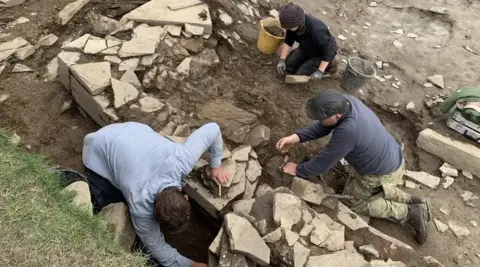
The latest work has again been made possible by funding from Time Team, for a new programme they will be making next year.
It will, according to Nick Card, involve “keyhole surgery” to open a small trench to investigate “this anomaly”.
He added: “We always said that when we put the trenches to bed, that was the end of the fieldwork.
“But last summer we conducted several types of geophysics and what that has showed up is something quite extraordinary.
“This was the first time this particular form of GPR had been used in Scotland.
“The preliminary results have just been amazing but we still have to get more analysed.
“All of this then needs to be stitched together and we’ll create 3D models of the site which will give us a much better understanding of the development of the Ness.”
The latest excavation will be open to the public for four weeks in July 2026.
But buildings previously on show prior to 2024 will remain covered up for preservation reasons.