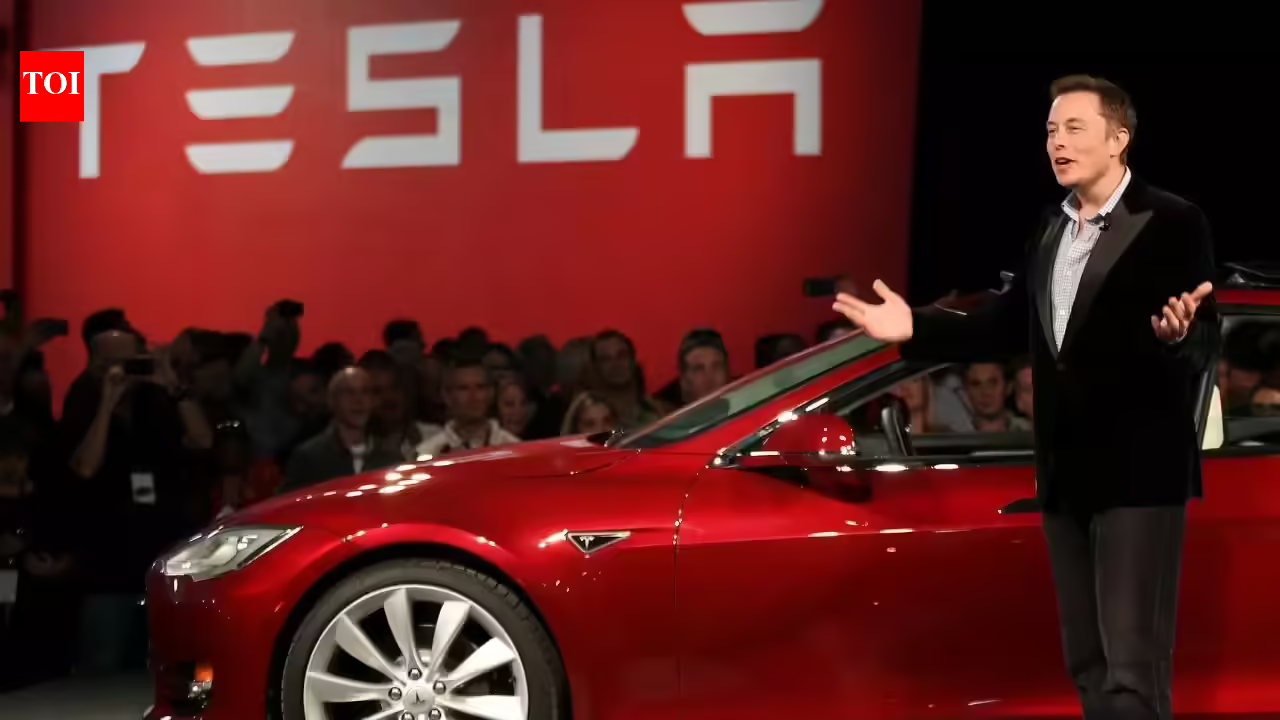
Elon Musk is back in the spotlight in China this week, joining a high-powered delegation of US executives, including Apple’s Tim Cook and Nvidia’s Jensen Huang, for a major summit between President Donald Trump and President Xi Jinping. For the world’s richest man, this is a delicate balancing act. While Musk is celebrated as a “global idol” by the Chinese public, he is simultaneously viewed with deep suspicion by the nation’s military.
Musk shares ‘EV vision’ with Beijing
Despite the geopolitical tension, Musk’s business goals align with China’s technological ambitions. Whether it is electric vehicles (EVs), artificial intelligence, humanoid robots or brain-computer interfaces, Musk is working on exactly what Beijing wants to master.“When you look at Beijing’s tech priorities, many of them line up almost perfectly with Elon Musk’s,” Kyle Chan, a fellow at the Brookings Institution, told Reuters.Tesla remains a dominant player in the country, selling roughly 626,000 cars in China last year alone. The report says that local automakers, like Chery, openly admit they use Tesla as a ‘blueprint’ for innovation, combining Musk’s software-first approach with traditional quality.
China army’s ‘SpaceX problem’ with Musk
However, the ‘love’ part of the relationship ends when it comes to space-based communications. While the Chinese government welcomed Tesla as the first foreign automaker to operate without a local partner in 2018, it is alarmed by Musk’s other venture: SpaceX.Reuters said that People’s Liberation Army (PLA) has expressed serious concern over Starlink, SpaceX’s satellite network. After watching Starlink provide critical communication edges during the conflict in Ukraine, Chinese military researchers have labeled the satellites a potential security threat. Fearing that the US could use Starlink during hostilities in Asia, Beijing is now racing to build its own domestic version of the satellite ‘megaconstellation.’
Musk: Social media icon in China
Musk remains a massive celebrity on Chinese social media, where he has millions of followers and is affectionately nicknamed “Brother Ma.” While his X social media platform is banned in China, Musk has 2.3 million followers on China’s Weibo. Even his mother has achieved celebrity status in the country.But the “Musk Era” in China may be facing its toughest test yet. As homegrown EV companies catch up to Tesla’s technology and offer lower prices, experts believe Musk’s influence may naturally start to fade.“As Chinese companies catch up or even overtake Elon Musk’s tech empire, his stature in China may start to dim,” said Chang Yan, founder of the popular EV blog Supercharged.