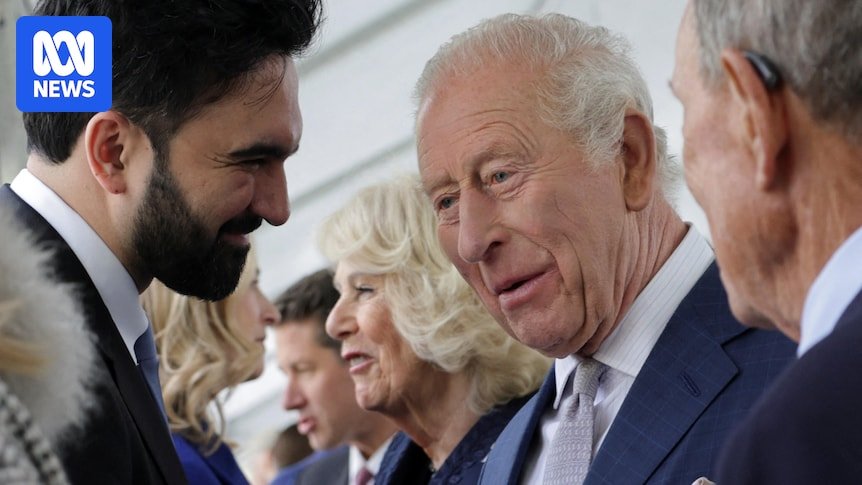
The United States pulled out all the stops for King Charles’s state visit with President Donald Trump.
Dinner was served on plates encrusted with pure gold. The royal family members were heaped with praise. And the King became only the second British monarch to deliver an address to Congress, after his mother, Queen Elizabeth II, in 1991.
But not everyone was gripped by royal fever.
The newly installed Democratic socialist mayor of New York City, Zohran Mamdani, was elected on a pledge to help the working class.
And on Wednesday (local time) in the city that never sleeps, Mamdani showed exactly what that would look like when it came time to meet the King.
Zohran Mamdani said if he were to speak to the king, he would “probably encourage him to return the Koh-i-Noor diamond”. (Reuters: Shannon Stapleton)
The pair both attended a wreath-laying ceremony in the city to honour victims of the 9/11 terrorist attack, but instead of rolling out the red carpet for the monarch, Mamdani’s team said the two men would not be meeting privately afterwards.
His spokesman, Joe Calvello, told the New York Times the mayor was “generally opposed to the idea of a king” and when Mamdani was later asked what he would say to Charles if they were to spend time together outside of the ceremony, he didn’t mince his words.
“I would probably encourage him to return the Koh-i-Noor diamond,” he told reporters.
Mamdani was referencing the most expensive diamond in the world, a precious stone surrendered by — or stolen from, depending on which side is telling the story — a young Indian prince and presented to Queen Victoria in 1850.
Born in Uganda to Indian parents who dedicated their lives to examining colonialism, Mamdani has been more than willing to speak on the issue in the past, most notably when discussing the resistance of Ireland to Britain’s “colonial project” in a St Patrick’s day speech in March.
With his latest comments he has again shifted attention from the pomp and circumstance of a calculated royal visit to the unsettled question of the Koh-i-Noor’s ownership and Britain’s colonial legacy.
The debate over a centuries-old diamond
British royal legend says the diamond will bring bad luck to any man who wears it.
Nowadays it mostly sits on display in the Tower of London, set in the front cross of the Queen Mother’s Crown.
But many Indians say it belongs to them and have been calling for its return for decades.
In 2023, after the death of Queen Elizabeth II, those appeals surfaced on social media and reached a fever pitch in the lead up to Charles’s coronation.
Queen Camilla chose not to wear the crown with the Koh-i-Noor at the event, opting to reuse another instead, apparently in an effort to avoid scrutiny.
But Mamdani’s comments indicate the subject has not been forgotten.
Believed to have originated in the Golconda mines in central southern India, the “Mountain of Light” has a long and complex history.
After it was discovered it was claimed by Mughal Islamic emperors, Sikh maharajahs and emirs of Afghanistan before it ended up in the hands of an 11-year-old Sikh maharajah in the 19th century.
Duleep Singh was leading modern-day Punjab, which was colonised by Britain after two bloody wars that killed thousands, when he signed a peace deal that led to the gem being handed to Queen Victoria.
It has been the subject of myth and intrigue ever since.
“Agatha Christie wrote a book about it and everybody believed it [was stolen]. It wasn’t,” Melbourne-based jeweller and author Gary Holloway said.
“It survived World War II, [then] it was moved from the Tower of London to Windsor Castle … in a hat box along with a lot of other very famous diamonds, part of the Crown Jewels.
“It was also hidden in a hole dug under the castle walls. Eventually it became part of the Crown Jewels.”
Once adorning Queen Mary’s crown, the Kohinoor was set in the front middle cross pattée. (Wikimedia Commons: Cyril Davenport )
Mr Holloway said multiple countries with connections to the eighth largest diamond in the world appealed to have the British surrender it.
“It’s been kidnapped all through its history,” he said.
“Iran wants it, Pakistan wants it, Afghanistan wants it.
“The fact that multiple invaders owned it means India is just one in the chain of people who claim it.“
Since 2000, some Indian politicians have been calling on Britain to return the Koh-i-Noor, seeing its loss as symbolic of the country’s subjugation under colonial rule.
“Britain owes us. But instead of returning the evidence of their rapacity to their rightful owners, the British are flaunting the Koh-i-Noor on the Queen Mother’s crown in the Tower of London,” prominent Indian MP Shashi Tharoor has said.
But just like the debate over countless other treasures taken from other countries during colonial wars that were subsequently put on display in the British Museum, the diamond controversy has not been easily solved.
Royal watchers have pointed out that King Charles doesn’t technically own the Koh-i-Noor, and therefore has no more power to return the diamond than he has to hand Buckingham Palace over to the people.
Mamdani snub not the only headline-making moment
King Charles’s visit to the United States marked the 250th anniversary of its independence and was designed to help repair the country’s “special relationship” with the UK.
Ties between Mr Trump and UK Prime Minister Sir Keir Starmer rapidly deteriorated this year because of the latter’s reluctance to join the war in Iran.
It was thought King Charles could help smooth things over while in the US, given Mr Trump’s interest in the royals.
The president’s excitement in the lead up to the visit indicated there was merit in the idea. But the trip was not without hiccups.
Donald and Melania Trump (right) welcomed King Charles and Queen Camilla to the White House last week. (Reuters: Kevin Lamarque)
Before King Charles touched down in America, maintenance crews plastered lampposts near the White House with the Australian flag instead of the Union Jack.
More consequential were calls from some in parliament for King Charles to cancel the trip after Mr Trump threatened to hit Britain with more tariffs.
Then there was a report in the Financial Times, which obtained audio of remarks made by the new British ambassador to the US, Christian Turner.
Mr Turner said it was “extraordinary” to him that the scandal over Jeffrey Epstein’s powerful associates had “brought down a senior member of the royal family, a British ambassador to Washington, potentially the prime minister, and yet here in the US it really hasn’t touched anybody”.
The comments followed calls for the King to meet with Epstein survivors on this trip, and for him to reference them in his speech to Congress. Charles opted to do neither.
What the King did do was mention three of Mr Trump’s most hot-button political issues in the most closely watched event of the visit: his historic address on Capitol Hill to a joint meeting of the Senate and House of Representatives.
NATO, Ukraine and climate change were touched on in quick succession, but Mr Trump didn’t seem to mind, describing Charles as an “elegant man” once admired by his late mother.
Loading…
“My mother had a crush on Charles. Can you believe it? Amazing how … I wonder what she’s thinking right now,” the president said earlier in the week.
Charles, for his part, allowed the president to flatter him. He joked with him at a state dinner on Tuesday about the 1814 British firebombing of the White House and a battle between Britain and France to control North America in the 18th century.
“If it wasn’t for us, you’d be speaking French,” he quipped.
In his speech to Congress, the King alluded to recent problems in UK-US relations, telling the audience that “we can perhaps agree that we do not always agree”.
He also pointed out the two countries had an enduring partnership “born out of dispute”.
Meanwhile, Mr Trump avoided mention of any policy disagreements with the Starmer government and largely stuck to script, except when he suggested, without evidence, the King “agrees” with him that Iran should not have nuclear weapons.
But does this mean the special relationship between the US and the UK is repaired?
Trump says ‘we’ll find out’ about mending ties
If history is anything to go by, the special relationship between the UK and the US will not be so easily fixed.
Donald Trump (left) and Sir Keir Starmer at the White House in February 2025. (Reuters: Kevin Lamarque)
Last year Mr Trump stood next to Sir Keir at a White House press conference and praised him for his “beautiful” accent.
He has since mocked his British counterpart, labelled him a “coward” who was “not Winston Churchill” and said he was “not happy with the UK” over its stance on the Iran war.
“It’s very sad to see that the relationship is obviously not what it was,” Mr Trump told The Sun newspaper last month.
When asked if Charles’s visit could improve relations, the US president told the BBC “absolutely, the answer is yes [it could help relations]”.
But he appeared to walk that back in comments he made to Sky News last week.
“I can’t give you an answer to that,” he said.
“I can tell you one thing, our relationship is very good, but you know, that’s another individual. We’ll find out.“
He added that Sir Keir “has to learn to deal the way [King Charles] deals, and he’ll do a lot better”.
Certainly both men have had to manage the fallout of similar controversies of late, but what draws Trump to the King — the status of being a royal, his family and their lifestyles — is not easily replicated.
In the meantime, many issues between the two countries remain, including the ongoing fallout of the Iran war and reports the US drafted a proposal to withdraw support for British sovereignty in the Falklands.
At the very least, Sir Keir might be hoping the monarch’s visit and soft diplomacy efforts will ease Mr Trump’s ire in the short-term.