

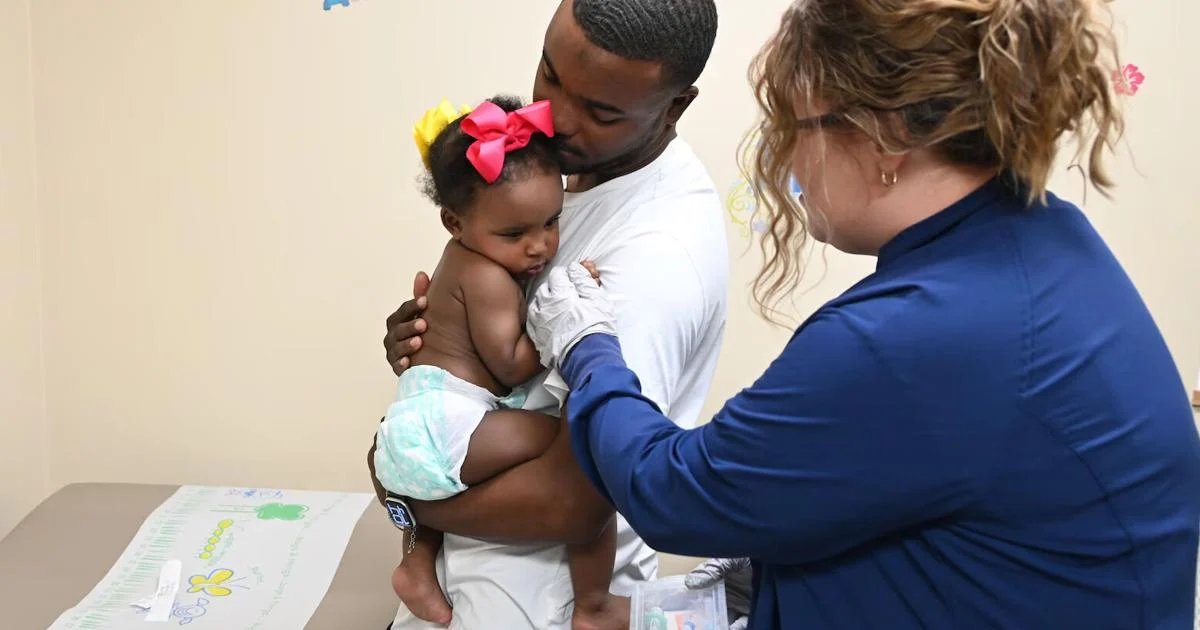

Klarissa Parsons, registered nurse, Carl R. Darnall Army Medical Center pediatrics, prepares to administer the MMR (measles, mumps, and rubella) vaccine to Autumn Campbell, March 14, 2025, as dad Spc. Tyrece Campbell, chemical specialist, 181st Chemical Company, 2nd Chemical Battalion, 48th Chemical Brigade, comforts her at the Pediatric Clinic at then–Fort Cavazos.
A single case of measles can sideline a Soldier, disrupt a unit and compromise mission readiness. In today’s interconnected world, vaccination against highly contagious diseases like measles is not just a personal health decision; it is a combat readiness imperative.
As measles cases continue to increase across the United States, Carl R. Darnall Army Medical Center’s Public Health and Nursing Department is urging Fort Hood and Central Texas residents to take extra precautions when traveling — especially to areas experiencing active measles outbreaks — and to ensure they are up to date on recommended vaccinations.

Carl R. Darnall Army Medical Center’s Public Health and Nursing Department is urging Fort Hood and Central Texas residents to take extra precautions amid growing measles outbreaks.
According to the Centers for Disease Control and Prevention, there have been 733 confirmed measles cases reported so far in 2026, with cases reported in at least 20 states, including Texas, Arizona, California, Florida, Georgia, Oregon, Utah and Virginia, as of Feb. 12. The majority of these cases are associated with outbreaks that began in 2025.
One of the largest outbreaks currently is in South Carolina, where health officials report 933 confirmed cases, as of Feb. 12. In that outbreak, most people infected are unvaccinated, and hundreds of contacts are under quarantine as health departments work to limit the spread, the CDC reported.
Measles is highly contagious — so much so that someone with measles can spread the virus to others before symptoms are obvious and measles virus particles can linger in the air for up to two hours after an infected person leaves the room. Typical symptoms begin with fever, cough, runny nose and red eyes, followed by a characteristic rash. Severe complications can occur, especially in young children, adults over age 20, pregnant individuals and people with weakened immune systems.
“It’s very important to consider the measles, mumps and rubella (MMR) vaccine as it’s the most effective protection against measles, especially for our younger population and other high-risk groups,” said Yesenia Montoya, communicable disease lead and registered nurse, Army Public Health, CRDAMC.
The CDC recommends two doses of the MMR vaccine: the first at 12-15 months of age and the second at 4-6 years old. One dose of MMR is about 93 % effective at preventing measles, and two doses increase that protection to around 97 %.
Adults who are unsure of their vaccination status or who have not received both doses are encouraged to speak with a health care provider, especially before traveling. Infants too young to be fully vaccinated, pregnant people and those with weakened immune systems are at higher risk for severe disease and often depend on community immunity for protection.
“Travelers should check current outbreak information, practice good hygiene, monitor for symptoms after travel and seek medical care promptly if symptoms develop,” Montoya added. “Taking preventive steps now can help protect individuals, families and the broader community from the spread of this preventable disease.”
If someone is concerned about possible exposure or want to ensure they and their loved ones are up to date on vaccines, they can contact a health care provider by phone, use the patient portal at patientportal.mhsgenesis.health.mil or call patient appointment service at 254-288-8888. If someone has measles or suspects exposure, they can share this information with their health care team when making appointments. To reduce the chance of spreading measles, wear a mask before entering a health care facility.
For more information about measles, travel recommendations or vaccination guidance, residents are encouraged to contact their health care provider or local public health department. Residents can also call the Nurse Advice Line 24 hours a day at 1-800-TRICARE (1-800-874-2273), option 1.