

How Celebrity Smear Campaigns are Inspiring Attacks on Birth Control
Throughout March, I was hit over the head with social media posts attacking Chappell Roan, an LGBTQ popstar who’s often labeled as ‘difficult’ or ‘aggressive.’ It’s transparently misogynistic: young women are always ‘difficult’ when they set boundaries or ask for respect, while male artists face none of the same backlash—even after committing abuse.
Predictably enough, a BuzzFeed report showed that many of the users behind sexist content about Chappell were bots or social media accounts quite literally created to drive the online smear campaign. Don’t get me wrong—social media is a sexist cesspool. But these public orgies of misogyny aimed at celebrity women are rarely as organic or innocuous as they seem. And as a fairly online woman in her twenties, I was the algorithm’s perfect target.
The pink pill pipeline, through which young women are exposed to anti-feminist ideologies disguised as ‘lifestyle’ content, isn’t always limited to ‘tradwife’ TikToks. Increasingly, this pipeline revolves around pop culture and celebrity news. Most young women and girls likely don’t even realize that news about their favorite artist or moviestar might just be a Trojan Horse for ultra-conservative horseshit.
While working at the feminist magazine Jezebel in 2022, I had the unique vantage point of reporting concurrently on three seismic feminist stories: the overturning of Roe v. Wade, the Amber Heard and Johnny Depp trial (including the pervasive online backlash against Heard), and a surging trend of anti-birth control social media content.
The timing was no coincidence: in both politics and culture, bad actors were fomenting anti-feminist sentiment among young women, just as the Supreme Court had more or less relegated us to second-class citizens. We were being primed to disbelieve victims or, worse, believe that we deserved abuse. And we were being primed to accept not just the loss of our right to abortion, but eventually our right to birth control.
Four years later, I’m watching the same phenomenon at record speed—with conservative billionaires and powerhouse organizations weaponizing seemingly harmless celebrity news to draw in a new generation of young women.
In the digital age, there is a playbook to drive targeted, mass harassment against celebrity women. This typically involves astroturfing tactics from paid professionals, who disseminate talking points or specific lines of attack against famous women to influencers, who then set the discourse in motion. Bots and misogynistic, misinformed masses of social media users will take the hate campaign from there.
Media literacy, fact-checking, and critical thinking have become such a rarity that online hate campaigns against celebrity women can go a mile a minute—just look to Blake Lively’s sexual harassment lawsuit against her boss, Justin Baldoni, for extensive evidence of what these coordinated campaigns entail. Or look at the tactics of Johnny Depp’s team against Heard. The public eats misogynist hate campaigns up every time.
You might be tempted to shrug these patterns off as apolitical, irrelevant ‘celebrity news.’ And that’s exactly what conservatives and the anti-abortion movement are counting on: for us to look the other way while they co-opt this very playbook to attack hormonal birth control, abortion, IVF, domestic violence victims, and more—targeting young, female audiences, in particular.
The right’s goal is plainly to get as many young women knocked up as early as possible: the Health and Human Services Department just released a proposed 2027 budget that eliminates the Teen Pregnancy Prevention Program. A Fox News analyst recently called it “a problem” that the birth rate among teens ages 15 to 19 is down. Former Trump administration official and current female lifestyle podcaster Katie Miller complained the same, tweeting that women and girls’ “biological destiny is to have babies—not slave behind desks chasing careers while our civilization dies.”
The message here is clear: teen girls and women shouldn’t be in school or pursuing careers—they should be having babies. While GOP lawmakers pass legislation to strip away our ability to choose school or work, influencers like Miller try to convince us that this is what we want.
Consider Evie Magazine—the Peter Thiel-backed, conservative women’s media outlet that goes out of its way to conceal its conservatism beneath flowery language about ‘celebrating femininity.’ Most of Evie’s content isn’t overtly about politics, but seemingly apolitical celebrity news and health and fashion advice. I’ve increasingly encountered Evie’s social media posts organically, out in the wild, sometimes “liked” or shared by young women I know—women who probably don’t realize they’re interacting with content from a far-right political movement that wants to ban birth control.
A young woman my age might come across Evie via their Instagram explore page, should they see the magazine’s posts about how Timothee Chalamet is eager to become a father. They might see Evie’s quote graphics of Katherine Schwarzenegger saying she can’t live without her husband. Perhaps they’ll be drawn in by Evie’s posts about trendy new “raw milkmaid” dresses, or the magazine’s praise for Zendaya saying she’ll take a step back from Hollywood when she has kids. Maybe they’ll be roped in by retweets sharing Evie’s buzzy headlines about how studies show women with bigger boobs face more hate.
Next, they might go to Evie’s website, where they’re likely to see articles smearing birth control with false claims about its safety and side effects. Independent journalist Emily Amrick recently reported that Evie averages around one anti-birth control article per month. Coincidentally, Evie plans to launch a wearable period-tracker that collects data about your cycle. (Thiel also happens to own Palantir, the surveillance conglomerate that works closely with the U.S. government.)
Or, young women may see Evie’s articles arguing that feminism has actually made women’s lives worse, that we need husbands to provide for us, that our lives are meaningless without children, and so on and so forth.
This is the pink pill pipeline. Conservatives know exactly what they’re doing: creating cultural consensus for their repressive political agenda. Through the Heritage Foundation, conservatives have articulated a 250-year plan for the U.S. in which young women will ‘voluntarily’ forgo work and school and pop out an endless flow of babies—because there are no other options.
Evie Magazine is hardly alone. There’s a rapidly growing, million-dollar creator economy of “tradwife” and female lifestyle influencers. Speaking of the Heritage Foundation: researcher Emma Waters—best known as the White House birth rate whisperer—has a new book that she’s promoting with videos on how women can strive to be both a “girlboss” and a “tradwife” in one—by being a “side hustle trad-wife.” (AKA: You can run from an Etsy shop or take on a part-time job—so long as you put your children and husband first, of course!)
And in 2024, far-right influencer Candace Owens launched a media company offering podcasts and hot takes on celebrity news and pop culture, a book club, and a fitness app for young mothers. All of that sounds fairly apolitical, right? But users reeled in by Owens’ fitness app might then start watching her YouTube videos—like her 11-minute video denouncing hormonal birth control as “unnatural.” Or her endless rants about how women belong in the home—even as she herself runs a multi-million dollar business. Perhaps young women who come across Owens’ takes on celebrity news will find her tweets stating, “Can you name one objective thing that has gotten better in American society since women were given the right to vote?”
That’s right: conservatives are increasingly trying to convince young women that we don’t want our right to vote. A growing contingency of conservative women—who first amass their online platforms by posting mainstream, seemingly apolitical content—vocally oppose women’s suffrage. While some conservative influencers openly advocate for the reversal of the 19th amendment, others, like Elon Musk, call for “childless adults” to lose voting rights. These implicit and explicit attacks on our voting rights, increasingly being mainstreamed by popular influencers, should terrify us. This agenda is clearly what the right has their sights on next—no matter how radical or unlikely such an outcome might seem right now.
It’s not hard to imagine why they’re targeting women’s suffrage: abortion rights just keep winning at the ballot box, and abortion will continue to win—unless a new generation of voters is convinced that we don’t want our rights.
This playbook—reeling in young women via a pipeline of seemingly apolitical content, then indoctrinating us with anti-feminist messages—doesn’t always lead users to outlets like Evie or Owens’ media company. Users might just see an onslaught of TikToks or Instagram posts, seemingly uncoordinated, but with the same anti-feminist message.
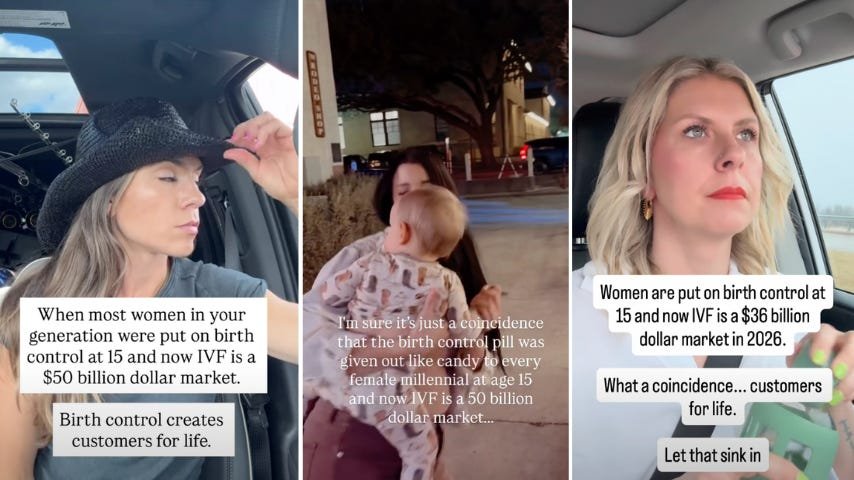
Amrick reported last month on a trend of female lifestyle influencers who don’t outwardly have any connection to each other or right-wing actors, espousing the same wholly baseless claims: that hormonal birth control ruined a generation of women’s fertility, propelling the demand for IVF today. Per Amrick, this is the uniform message that hordes of female lifestyle influencers are sharing: “Isn’t it just a coincidence that we handed out the birth control pill to an entire generation of women—and now those same women need IVF?”
I’ve been reporting on anti-feminist smear campaigns, anti-abortion lies, and right-wing media strategies for years now—so I can see through these posts as the astroturfed slop that they are. The problem is, many young women aren’t journalists or aware of the pink pill pipeline. Many will see the sheer volume of posts about the supposed dangers of birth control and conclude birth control is unsafe, or that IVF is an exploitative, predatory industry.
The goal is to flood the zone with so much anti-birth control content that young women believe we’re encountering this content organically. In reality, what we’re experiencing is a coordinated effort by right-wing actors, steadily manufacturing our consent to ban birth control—and more. The result? More and more women self-reporting worsened experiences with birth control as a self-fulfilling prophecy, according to researchers, or changing their contraceptive method based on what they’re hearing online.
Think of all the viral TikToks and Instagram reels over the last few years, featuring female lifestyle influencers who warn that birth control is over-prescribed, that hormonal birth control is unsafe and we should try these ‘natural’ alternatives. Now look at the language of the Trump administration’s new guidelines for future Title X grantees, claiming birth control is over-prescribed and emphasizing “natural family planning.” Even before these guidelines, in recent years, Congressional Republicans have blocked several efforts to codify a federal right to birth control. Growing online sentiment against birth control is meant to manufacture consent to these rising political attacks.
The strategy has been a long-time coming. I remember reporting on the seemingly organic online campaign against birth control as early as 2021 and 2022: anti-birth control videos—on TikTok in particular—were suddenly everywhere, sweepingly demonizing IUDs, recommending that young women switch to “natural birth control,” and even warning young women that birth control pills could make them gay. In 2022, Duke University researchers found 38% of the most viewed TikToks tagged #IUD had a “negative tone,” 28% expressed distrust of health workers, and a quarter promoted “moderately or highly inaccurate scientific claims.”
Videos I tracked at the time featured young women gushing about their experiences avoiding pregnancy without hormonal birth control, sometimes racking up millions of views and shares. Birth control-free family planning is “a lot easier than you might think,” one TikToker said. Other TikTokers recounted trauma and severe pain from IUD insertions, also garnering millions of views: “i need anyone who wants to get an iud understand it can be traumatic,” the caption of one such video reads. “it was traumatic for me.”
To be clear, much of this content has capitalized on legitimate experiences with birth control side effects. I’ve been on different birth control methods for over a decade now, and struggled for years to find the right method for me—I can see why TikToks like this appeal to women with similar experiences. But these videos fundamentally oversimplify the nuanced realities of birth control, and erase that on the whole, birth control is a public good. There’s good reason feminists fought for the right to contraception over the course of generations.
Everyone has different experiences with different birth control methods, and our health system has failed many young women as they search for the right method for them. But online, anti-birth control narratives flatten all of these complexities. Taken together, these social media posts are meant to convince young women that birth control is bad and, consequently, banning or restricting birth control is good.
All of the seemingly organic posts that are fearmongering about birth control, IVF, or other reproductive health resources are part of a broader political agenda—whether any of the influencers behind the posts outwardly identify as flagbearers for the Republican Party or not.
A 2021 Media Matters for America study revealed how quickly violent, far-right content can swallow up your entire “for you” or “recommended” feeds if you watch a single ‘manosphere’-adjacent video. Angelo Carusone, president of Media Matters, told me for my reporting in Jezebel in 2024 that misleading, dangerous products have always existed—“but you used to have to look for them. Now, they’re just being served to you in an endlessly refreshing feed.”
This phenomenon isn’t limited to the manosphere, which attracts young men first with ‘apolitical’ content about weightlifting and dating. Young women are also being radicalized in digital spaces. They’re also being lured by seemingly apolitical content—like celebrity gossip—and being steered to the likes of Evie Magazine or Candace Owens, who rail against feminism, abortion, birth control, and even voting rights.
Unfortunately, it’s hard to draw all of these connections—how Evie’s Instagram posts about Zendaya are part of a broader effort to ban birth control, for instance—without sounding like a deranged conspiracy theorist.
Fortunately, you don’t have to take my word for it, alone: you can take the word of the right-wing architects behind these efforts. Look no further than the Heritage Foundation’s detailed, 250-year plan for America, an effort to further embed conservatism into mainstream culture and prime us all to accept a slate of violent, dehumanizing legislative attacks on our bodily autonomy.
The right knows exactly what they’re doing—and they aren’t even a little shy about it.