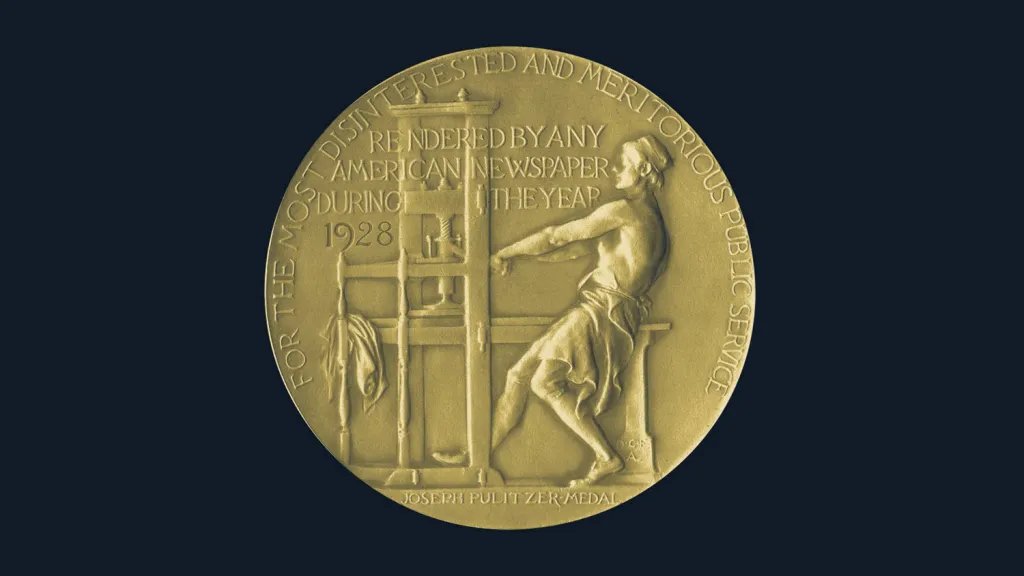
The New York Times, The Washington Post and Reuters were multiple winners of Pulitzer Prizes on Monday, while the journalism committee awarded a special citation to the Miami Herald’s Julie K. Brown for her reporting on Jeffrey Epstein.
A number of the winners reflected the fallout from the first year of Donald Trump‘s second term, with the Pulitzer committee recognizing stories and coverage of the administration’s conflicts of interest, the president’s campaigns of retribution, ICE raids and cutbacks to the federal workforce.
The Post was recognized in the public service category for “piercing the veil of secrecy around the Trump administration’s chaotic overhaul of federal agencies and chronicling in rich detail the human impacts of the cuts and the consequences for the country.”
The Post’s team covering the cuts included Hannah Natanson. Federal agents searched her home in January and seized her electronic devices, as part of an investigation of a federal contractor accused of possessing classified documents. Natanson was told she was not the target, but the Post has been in litigation against the government to return her items. The Pulitzer Prizes cover 2025, before the Post slashed at least 1/3 of its workforce, in February.
Marjorie Miller, the administrator of the prizes, pointed to the “robust” field of nominees despite the economic pressure on news outlets.
She also referenced the president’s attacks on the media, noting that the prizes stand for the First Amendment and an independent press. “Unfortunately, this bears repeating now as media access to the White House and the Pentagon is restricted, free speech is challenged in the streets and the president of the United States has filed lawsuits for billions of dollars for defamation and malice against multiple print and broadcast media,” she said. Trump’s litigation even includes the board of the Pulitzers, as he sued them because they refused to retract their honors to the Times and the Post for their coverage of the Russia investigation.
Brown was recognized for reporting on Epstein from 2017 and 2018. The judges said that her series, Perversion of Justice, “revealed how prosecutors shielded Epstein from federal sex trafficking charges when he was first accused of abusing young women.”
The judges said that Brown “went on to document and give voice to the scores of victims who had been groomed and abused by him and others in his circle. Her work, and the release of the government’s Epstein files, continue to reverberate around the world.”
The winners of the journalism awards, with some of the judge’s comments, are:
Public service: The Washington Post, for coverage of the overhaul of federal agencies.
Breaking news reporting: Staff of the Minnesota Star Tribune, for coverage of the mass shooting at Annunciation Church and School in Minneapolis, as students were attending a back-to-school Mass.
Investigative reporting: The New York Times, for stories on Trump administration conflicts of interest and “the moneymaking opportunities that come with power, enriching his family and allies.”
Explanatory reporting: Susie Neilson, Megan Fan Munce and Sara DiNatale of the San Francisco Chronicle, for a series on how insurance companies used algorithmic tools to undervalue properties destroyed by fires.
Beat reporting: Jeff Horwitz and Engen Tham, Reuters, for reporting on Meta’s “willingness to expose users, including children, to scams and AI manipulation.”
Local reporting: [tie] Dave Altimari and Ginny Monk of the Connecticut Mirror and Sophie Chou and Haru Coryne of ProPublica, for a series on how the state’s towing laws favored “unscrupulous companies.”
Staff of Chicago Tribune, for coverage of the the Trump administration’s immigration crackdowns and the resistance that followed.
National reporting: Staff of Reuters, notably Ned Parker, Linda So, Peter Eisler and Mike Spector, for “documenting how the president used the U.S. government and the influence of his supporters to expand executive power and exact vengeance on his foes.”
International reporting: Dake Kang, Garance Burke, Byron Tau, Aniruddha Ghosal and Yael Grauer, contributor, of the Associated Press, for an investigation into the tools of mass surveillance that were created in Silicon Valley and have spread across the globe, including “secret new uses” by the U.S. Border Patrol.
Feature writing: Aaron Parsley of Texas Monthly, for his personal account of losing his nephew and his home in the floods of Central Texas.
Criticism: Mark Lamster of the Dallas Morning News, for architecture criticism.
Opinion writing: M. Gessen of The New York Times, for essays on rising authoritarian regimes “that draw on history and personal experience to probe timely themes of oppression, belonging and exile.”
Illustrated reporting and commentary: Anand RK and Suparna Sharma, contributors, and Natalie Obiko Pearson of Bloomberg, for trAPPed, an account of a neurologist in India “held under ‘digital arrest’ by her phone.”
Breaking news photography: Saher Alghorra, contributor, The New York Times, for a series on the devastation and starvation in Gaza.
Feature photography: Jahi Chikwendiu of The Washington Post, for a photo essay “on a young family welcoming the birth of their first child as the father is slowly dying from cancer.”
Audio reporting: Staff of Pablo Torre Finds Out, for a “pioneering and entertaining form of live podcast journalism,” an investigation into how the Los Angeles Clippers “seemingly evaded the NBA’s salary cap rules by funneling money to a star player through an environmental startup.”