
You May Also Like


In this study, hierarchical (multilevel) models were used to reflect the nested data structure, with repeated observations within students and students within schools. This approach accounts for dependencies among observations, enables appropriate partitioning of variance across individual and school levels, and captures unobserved heterogeneity across schools through random effects (e.g., differences in building characteristics and practices). Longitudinal modeling accounted for repeated observations over time and leveraged within-student variation in exposures and outcomes, allowing each student to serve as their own control. This improves statistical efficiency and reduces bias from unmeasured, time-invariant individual characteristics that may influence absenteeism. Longitudinal models are particularly well suited to absenteeism outcomes, which are episodic and vary over time in response to environmental conditions and illness dynamics.
Whereas some previous studies did not have data on specific reasons of absence and therefore studied the associations between ventilation rates and absence due to broader range of illness or medical conditions [24], our study focused specifically on absence due to RI and GI. It was also noticed that results for total absence days or rates are somewhat contradictory. For example, higher ventilation rates associated with more absences, while higher biocontamination levels associated with fewer absences. Total absences include various non-illness-related reasons (e.g., unexcused absences, family events, appointments), which may not accurately reflect the impact of school environment and IEQ on student health. Additionally, school-level differences in recording illness-related absences could not be accounted for in the total absence models.
Student-level data revealed significant associations between the number of days absent and various factors and covariates in the models. In our study, grade level was treated as a continuous variable because it also represents student age. At the school level, we included the mean student age to account for demographic differences between schools (mean age across elementary school grades is 9, middle school 13, and high school 16). It is noteworthy that behavioral patterns change with age: young children tend to remain in one classroom, whereas middle and high school students increasingly rotate between rooms. It is reasonable to assume that this transition occurs gradually across grade levels. Including school type (elementary/middle/high school) as a factor (categorical variable) in the models had only modest effects on parameter estimates and did not alter our conclusions regarding the renovation effect (data not shown).
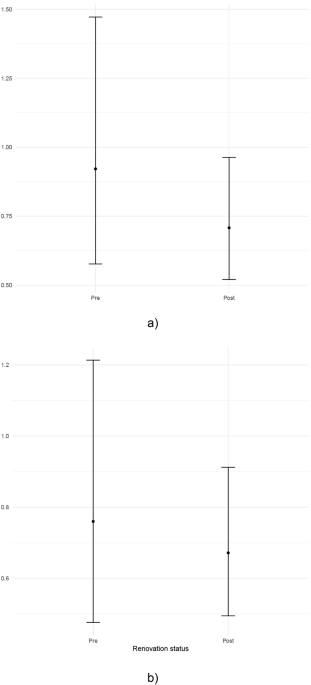
In the student level models, renovation status associated with both RI and GI and remained significant after IEQ parameters were added, where number of days absent were significantly lower after renovation. Changes in the IRRs indicate that the associations with renovation status were at least partly related to changes in IEQ. In contrast, while school-level daily absence rates could be used to track and even predict absences across school districts, the statistical power was lower, and the associations were weaker.
COVID-19 substantially altered absenteeism patterns. The effects of COVID-19 were examined on a year-by-year basis. While the estimates were comparable across other years, they differed markedly for the 2019–2020 and 2020–2021 school years. This was likely due to school closures beginning in spring 2020 and changes in school operations during the 2020–2021 school year. Operations then returned to normal during the 2021–2022 school year. Excluding data from the 2019–2020 and 2020–2021 school years resulted in stronger associations between renovation and both RI and GI absenteeism in student-level models (Tables S3 and S4). In contrast, associations in school-level models were largely unchanged, except for total absence rate, which reached statistical significance (Table S6). Estimates for IEQ parameters remained comparable across models, supporting the conclusion that the findings are robust and reliable.
Many classrooms had inadequate ventilation before renovations, and in some classrooms, ventilation rates stayed below the recommended minimum even after renovations [13]. Higher VR associated with lower number of days absent due to RI (IRR 0.94) in the student level model and lower absence rate due to RI (IRR 0.98) in the school level model.
Other indicators of ventilation performance, such as peak CO2 levels and ACR, were analyzed using a novel methodology to segment build-up and decay periods [13]. However, VR provided better goodness of fit in illness absence models, possibly due to lower variability compared to CO2 and the challenges of interpreting ACR relative to space volume. Thus, VR may be a more reliable indicator of ventilation performance in relation to illness absences.
Indoor T was within recommended ranges in most classrooms both pre- and post-renovation. In student level models, higher indoor T was associated with higher number of days absent due to RI (IRR 1.40) and GI (IRR 1.34). In the school level models higher indoor T associated with higher GI absence rate. It appears that within the range of 20 °C–24°C, cooler temperatures could be more beneficial for school health.
It should be noted that that indoor T is not a deterministic function of outdoor T [25]. Mechanical heating, ventilation system operation, classroom occupancy, and building envelope characteristics can all produce substantial divergence from outdoor conditions. Moreover, indoor T interacts with indoor humidity in ways that are directly relevant to pathogen survival and transmission. For these reasons, indoor T provides meaningful exposure information beyond outdoor T alone.
Both RH and AH in the monitored classrooms were lower after the renovations, and it could to some extent be related to higher ventilation rate during the cold season. However, due to low outdoor ambient humidity values during winter, optimal indoor humidity may not be reasonably always achieved. Low RH has been associated with discomfort, irritation symptoms, and potentially increased spread of infectious diseases. Therefore, an intermediate RH (40–60%) has been recommended [26], though no universally accepted health-based guidelines for indoor RH or AH exist.
Based on this study, higher indoor AH (in grams per cubic meter of air), was associated with lower RI and GI. When all IEQ variables were included in the models, higher indoor RH associated with higher number of days absent due to RI and GI, but when indoor T and RH were removed, the association between RH and RI turned negative (higher RH associated with lower number of days absent), and the positive association between RH on GI was diluted. In the school level models, higher AH associated with lower RI absence rate. It appears higher amount of moisture in the air could be protective of health, whereas RH is dependent on both AH and indoor T and may have indirect influence.
Given that RH is dependent on both indoor T and AH, it is difficult to differentiate their effects. However, their relationship is not straight forward: whereas T directly relates to the amount of moisture the atmosphere can hold, AH in relation to that amount determines RH. Indoor AH is impacted by both outdoor AH and indoor generated moisture and moisture removed by air conditioning. Nevertheless, the goodness of fit (based on QICC) was better for models including all three variables, with consistent findings for indoor AH and T.
Peci et al. (2019) reported a negative association between outdoor AH and T and influenza, whereas the effect of outdoor RH was controversial [27]. Also, Wiemken et al. (2017) found outdoor AH negatively associated with hospitalizations due to influenza [28]. Our results were similar for RI, GI, and total absence rates. On the other hand, in the student level models, higher annual average outdoor AH corresponded with higher number of days absent due to RI and GI. Higher annual average AH could be related to, for example, precipitation.
It has been reported that higher RH rather than AH is beneficial for indoor air pathogens’ survival [29, 30]. In our models, where both indoor T and AH were included, higher indoor RH associated with higher number of days absent due to RI and GI, but the effect turned opposite when indoor T and AH were not included. It is possible that the effects of T and/or AH mask the opposite effect of indoor RH, when all three variables are not included (e.g., due to multicollinearity issues when sample sizes are too small).
ATP is a measure of biological contamination, and high correlations have been found between ATP levels on desktops and microbes including bacteria, fungi, and yeast [31], but not viruses [32]. ATP monitoring showed a decrease in pre-cleaning ATP levels after renovation, while post-cleaning levels remained unchanged. These results suggest that cleaning effectiveness improved due to more frequent cleaning, but the cleaning methods themselves were not more effective. Higher pre-cleaning lgATP associated significantly with higher number of days absent due to GI (IRR 1.15), but the association with RI (IRR1.06) did not reach statistical significance (p < 0.10). We could speculate that the stronger associations with GI suggest it may be more easily transmitted through inanimate objects.
To summarize, our results indicate that more than one-third of absences related to RI and GI could be reduced by upgrading school facilities and following recommended standards for ventilation and surface cleanliness. Indoor environmental parameters represent distinct, proximal exposures that may mediate renovation effects but also remain important to model for interpretation and policy relevance. For example, a linear reduction in RI was observed with VR increasing from 2 to 13 L/s-person, while GI was reduced with ATP levels decreasing from 10⁶ to 10⁴ RLUs. Further reductions could be achieved by maintaining higher humidity and cooler temperatures in classrooms, but adjusting these factors is more complex as they are influenced by outdoor climate. Nevertheless, consistent reductions in both RI and GI were observed with AH increasing from 3 to 7 g/m³ and T decreasing from 24 °C to 20 °C. We also acknowledge that future work could apply formal causal mediation methods to quantify indirect effects more rigorously.
Overall, this study conducted IEQ monitoring before and after renovations, with feedback provided to facility management. Improvements were observed in ventilation rates, biocontamination levels on high-touch surfaces, and more consistent indoor temperatures. The findings highlight the importance of maintaining good IEQ in schools to promote student health and reduce absences due to infectious diseases.
