

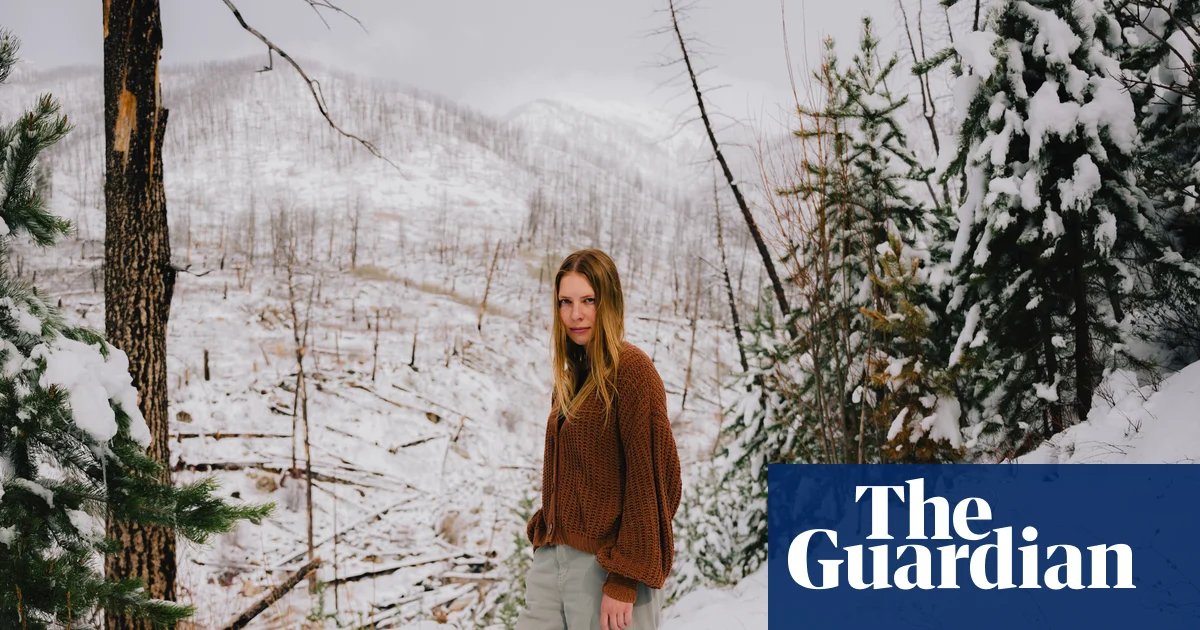
Eva Lighthiser was at a dorm party on her Colorado college campus last month when she had to call it an early night.
“I said, ‘Hey, I’ve got to go to bed, I’m flying out to Portland tomorrow,’ and then of course follow-up questions get raised,” she said. “I’m like, ‘Well, it’s a lot to explain.’”
When the 20-year-old climate activist isn’t deciding her major – she is leaning toward environmental studies – she is preparing testimony for her lawsuit against the US president, Lighthiser v Trump. She and 22 other young Americans are accusing the US federal government of violating their constitutional rights by passing executive orders boosting planet-warming fossil fuels.
Even though a court dismissed Lighthiser v Trump in the fall, Lighthiser and her fellow plaintiffs went to Portland, Oregon, in April to push for it to be reinstated.
“We are challenging this administration for sacrificing the lives of myself and my fellow plaintiffs by expanding fossil fuels for the sake of power,” she said in a speech outside the courthouse.
It was a “nerve-racking, but invigorating” experience, Lighthiser said. In the coming months, the ninth circuit court of appeals, which covers Montana, will decide if it will reinstate the youths’ case.
Lighthiser’s affinity with the natural world was planted before she was born: her parents met as hiking buddies, and she grew up camping and climbing mountains in Livingston, Montana. During her first year of high school, she was home-schooled from the road, learning math and history while visiting national parks.
But she never imagined that her love for the outdoors would lead her to sue one of the most powerful people in the world. As a child, she was cautious, and even in adulthood, she does not naturally crave attention.
“Taking on Trump, it’s not the first thing that occurs to you that she would do,” said her father, Mark, donning a well-worn Carhartt hoodie. “I think Eva has had to push herself.”
‘My name against his’
Lighthiser has now had six years to push herself. She began hearing about youth-led climate litigation in early 2020. A family friend told her about Our Children’s Trust, a non-profit law firm that has been involved in dozens of legal actions against governments across the US. They were hoping to bring a suit in Montana, the friend said.
“I was like, wow, youth litigating,” Lighthiser said. “It felt like a novel idea.”
She began sitting in on the group’s Zoom calls and quickly decided to become a plaintiff in Held v Montana. Filed on her 14th birthday, the challenge alleged that her state’s pro-fossil fuel policies violated provisions the state constitution guaranteed, including the right to a “clean and healthful environment … for present and future generations”. In 2023, it became the first lawsuit of its kind to go to trial. On the stand, Lighthiser spoke about her love for Montana and the climate threats it faces. “My future feels uncertain,” she said.
In a groundbreaking win, the judge ruled in favor of the plaintiffs. They are now pushing the state to enforce that victory; they say state lawmakers have enshrined new laws that contradict the judge’s ruling and should be overturned.
It didn’t take long for Lighthiser to start thinking about the next challenge. In early 2025, she spoke at an event with Julia Olson, founder of Our Children’s Trust.
“It became clear early in the second Trump administration that a federal case was something to pursue,” Olson said. “Eva was actually one of the first youth who we were in conversation with and who wanted to be involved.”
That May, Lighthiser was standing in her family home driveway, preparing to head to an overnight bike trip in the nearby Paradise valley. “I got a call from one of my lawyers, and he was like, ‘Hey, Eva, what’s up? We’re talking about this federal case. What do you think about being the lead plaintiff?’”
The attorney explained the responsibilities of the role, including the expectation that she mentor younger challengers. The lawsuit also would be called Lighthiser v Trump, he said.
“That was really a moment when it clicked,” she said. “My name against his name.”
A climate crisis in Montana
Lighthiser can’t imagine growing up anywhere but Montana. A purple state with a long history of both conservation and environmental exploitation, it has sometimes been called a “resource colony” because its economy is driven by the extraction of raw materials to benefit wealthy moguls. The practice dates back to the 19th-century mining boom, and critics say it continues today, with, for instance, plans to mine more coal to send to east Asia.
But it is also a place where people of all party affiliations care about their local ecosystems, Lighthiser explained. An April poll found that 90% of Montanans, including 82% of Republicans, said conservation issues were important when deciding whether to support an elected official.
“There’s a lot of people who may not believe in climate change or be resistant to conversion to renewables,” she said while driving down Livingston’s main street. “But there’s also a sense that everyone knows how special this place is, can see the beauty around them.”
That beauty is visible all around Livingston, her “tight-knit, strange, little community of a town” that draws ranchers and artists, as well as celebrities such as Jeff Bridges, Michael Keaton and John Mayer. From the towering Gallatin and Absaroka Range mountains to the Yellowstone River and its winding, babbling tributaries, Livingston is picturesque.
But environmental threats are also visible everywhere. Blocks from Lighthiser’s family home, mile-long coal trains spew coal dust daily. A climate-linked parasite killed tens of thousands of fish in 2016, closing parts of the Yellowstone River. Most alarmingly, extreme floods, a rarity during Lighthiser’s early childhood, are now increasingly frequent. These deluges have upended her life, she said.
The Lighthisers used to live 15 minutes outside town by the Shields River, which was the subject of a journal entry by Capt William Clark during the Lewis and Clark expedition. In 2018, it flooded, washing out the bridge her family used to get into town. That forced the family to take a 30-minute detour each day – and ultimately convinced them to move.
They had just settled into their new home when the Yellowstone River, just a three-minute walk away, overflowed in 2022. The waters inundated homes and turned streets into streams, causing $128m in damages. But the community response amazed Lighthiser.
“In the following weeks, I remember there were a lot of efforts to clean up homes and help each other out,” she remembered. “I thought that was a really special thing.”
Youth-led climate litigation provides Lighthiser with a similar sense of togetherness – a banding together in the face of disaster. As a plaintiff in Held v Montana, she began to see her fellow challengers as “family”, thanks in part to the closeness fostered by lead plaintiff Rikki Held, who helped her feel confident speaking publicly and regularly checked in on challengers during the “emotional rollercoaster” of court proceedings, she said. Now, as a named plaintiff, Lighthiser hopes to do the same for her co-challengers.
She is accomplishing that goal, said Jorja McCormick, a 17-year-old plaintiff in the Lighthiser lawsuit who is also based in Livingston. McCormick first got to know Lighthiser when she spoke at the Green Initiative, an influential local climate club. Though she initially found the prospect of joining a lawsuit daunting, listening to Lighthiser’s speeches made the process seem approachable. “I definitely look up to the older plaintiffs like Eva,” she said.
Lighthiser’s mother, Erica, is proud of her daughter for uniting young environmentalists, but she fears the scrutiny that the lawsuit could bring – particularly from a president who seems to prioritize retribution against his political critics.
“Look, it’s our last name next to the president’s last name,” she said. “But I know there’s a sense of duty or responsibility to future generations. I see that in her.”
The future of youth-led climate litigation
Pat Parenteau, an environmental law expert at Vermont Law School, said he admired the courage Lighthiser and her fellow youth plaintiffs exhibited. But he worried about what cases like these could mean for environmental law at large. Though he had donated to Our Children’s Trust and offered their “very good lawyers” friendly legal advice, he fears their case could be seen as a form of overreach.
Lighthiser v Trump employs a sweeping set of arguments to call for several pro-fossil fuel executive orders to be blocked. That goes beyond what courts tend to see as their role, Parenteau said.
“The courts are not able to reform the energy system of the United States, and they’re not going to entertain requests for them to do that,” he said.
When Dana Christensen, the district court judge in Montana, dismissed Lighthiser v Trump last fall, he said he did so “reluctantly”, but that the scope of the requests made by the plaintiffs was “unworkable” and outside the jurisdiction of the court. Parenteau does not expect the ninth circuit court of appeals to reinstate the youths’ case, as Lighthiser and her fellow plaintiffs had asked it to do in Portland last month. If Our Children’s Trust then brings their lawsuit to the supreme court, they could risk a far less sympathetic judgment – one that could be used to “slam the door” on other kinds of environmental lawsuits, Parenteau said.
Courts have an easier time with cases that demonstrate injury has been caused by specific government actions, said Parenteau. The Lighthiser case instead makes the broad claim that certain executive orders – and the manifold policy decisions that they spark – are unconstitutional. That is a legally sound argument, he said, but not one that supreme court justices have “any chance” of backing.
“You’re playing with fire with courts nowadays,” he said. “I believe in their cause, because what they’re arguing is what the law ought to be, but it’s not what the law is.”
Olson declined to comment on whether she would take the case to the supreme court in the event of an unfavorable outcome from the ninth circuit court of appeals. Though she has “enormous respect” for Parenteau, she said concerns about negative court reactions to “bold constitutional arguments” had been “raised about every major civil rights advance in history, including cases that ultimately transformed American law”.
“The answer has never been to step back from the courthouse door,” she said. “Children are being harmed right now.”
She is optimistic that the case could receive a favorable judgment. But even if it doesn’t, bringing the lawsuits is still important because it educates judges about the climate harms facing young people, she said.
“If we don’t use our constitution, we will lose it,” she said.
Lighthiser agrees that bold climate litigation is necessary to push the courts forward. If her lawsuit is successful, it would set an “incredible legal precedent” and force the government to “acknowledge the fact that they are doing active harm to young people in this country”, she said.
Eventually, youth climate litigation will be successful, Lighthiser said: “There are risks. But if you never take risks, nothing good happens.”