
Now Reading: Kamala Harris vs. Gavin Newsom 2028 Presidential Election Chances: New Poll
- 01
Kamala Harris vs. Gavin Newsom 2028 Presidential Election Chances: New Poll

Kamala Harris vs. Gavin Newsom 2028 Presidential Election Chances: New Poll
A new early snapshot of the Democratic field suggests the race for the 2028 nomination is wide open, with no single candidate commanding clear first-choice support.
A nationwide poll conducted by Lake Research Partners, which describes itself as a “nonpartisan organization seeking better elections for all,” places former Vice President Kamala Harris narrowly ahead of California Governor Gavin Newsom, leading 52 percent to 48 percent in a ranked choice voting simulation—well within the margin of error.
Key Points
Only 43 percent pick Harris or Newsom as their first choice, showing a fragmented electorate.
Around 80 percent rank Harris or Newsom in their top five, boosting them in later rounds.
Ranked choice voting gains broad backing, rising from 63 percent to 70 percent after voters try it
Democratic positioning remains shaped by the fallout from the party’s 2024 defeat and continued voter concerns about the economy
A May poll of Democratic primary voters tested a hypothetical 2028 primary using ranked choice voting and found Harris narrowly ahead of Newsom.
Potential contenders face a race where building broad coalitions across party factions may matter more than securing a loyal base.
Safe embed will be rendered here
2028 Ranked Choice Democratic Presidential Election Poll
Service URL: https://public.flourish.studio/visualisation/29097300/embed
Why It Matters
Democrats are still recalibrating after their 2024 election loss, and early polling suggests no consensus candidate has yet emerged.
At the same time, ranked choice simulations point to a different type of contest—one shaped by transferable support across a crowded field rather than a simple plurality.

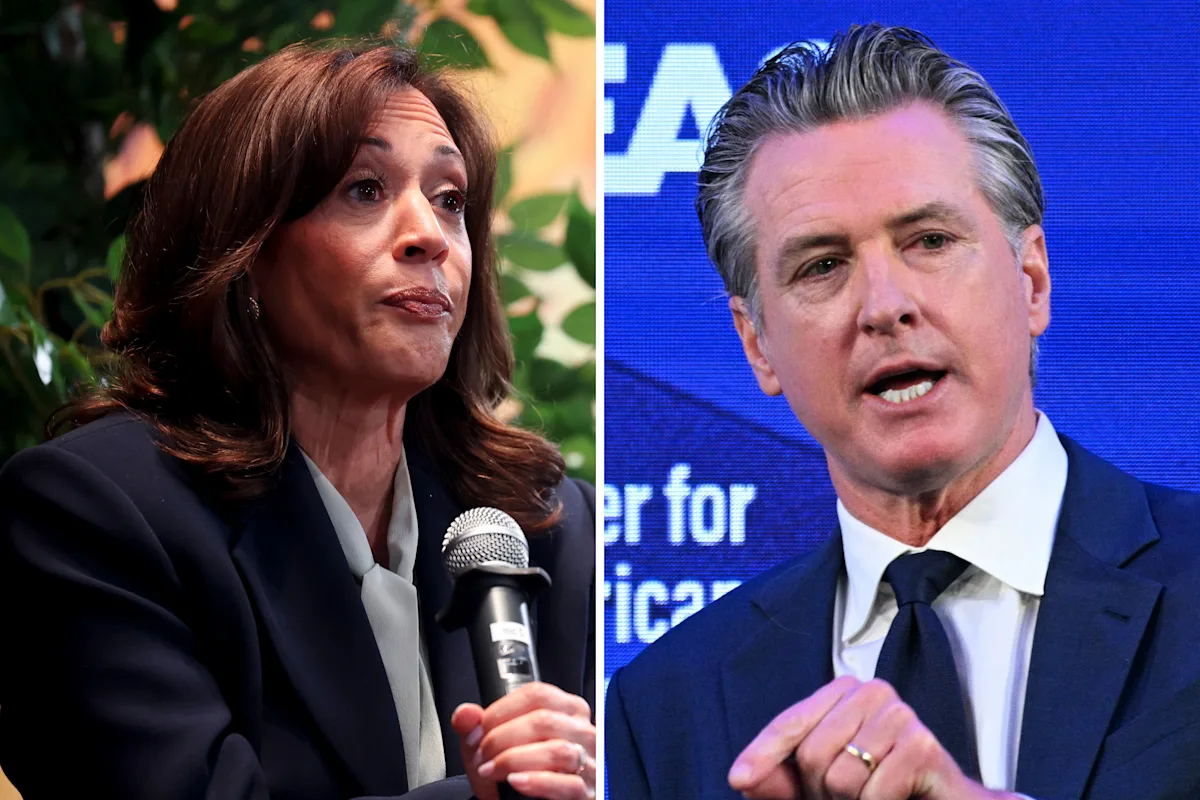
Left: Former Vice President Kamala Harris speaks during a fireside chat at MEET Las Vegas on May 07, 2026, in Las Vegas, Nevada. Right: California Governor Gavin Newsom speaks during the Center for American Progress (CAP) IDEAS Conference in Washington, DC on May 19, 2026.
What To Know
The Lake Research Partners survey was conducted online among 800 likely Democratic primary voters nationwide from May 6 to May 11, 2026, with a margin of error of plus or minus 3.5 percentage points.
Respondents were asked to rank up to five candidates from a list of 13 potential contenders, allowing researchers to simulate a multi-round contest rather than a single-choice vote.
Harris leads Newsom 52 percent to 48 percent in the final ranked choice count, a gap that falls within the margin of error and leaves the race statistically tied.
First-choice preferences tell a more fragmented story, with 26 percent backing Harris and 17 percent Newsom, meaning a majority of voters initially prefer other candidates.
How The System Drives The Outcome
Around 80 percent of voters rank either Harris or Newsom somewhere in their top five, allowing both to consolidate support as lower-ranked candidates are eliminated across successive rounds.
That process rewards candidates with broad acceptability across factions rather than concentrated first-choice support, reshaping how early polling needs to be interpreted.
Voters who back progressive figures such as Alexandria Ocasio-Cortez tend to list Harris as a fallback option, while those aligned with figures like former Secretary of Transportation Pete Buttigieg and other mainstream Democrats more often shift toward Newsom.
Harris, Newsom and Buttigieg each appear in the top five rankings of at least 55 percent of respondents, while a second tier of candidates—including Arizona Senator Mark Kelly, Ocasio-Cortez and Pennsylvania Governor Josh Shapiro—are included by about one-third.
Support for ranked choice voting reaches 63 percent and rises to 70 percent after respondents complete the ballot exercise, underscoring growing openness to electoral reform within the Democratic electorate.
What Other 2028 Polls Show
Other early surveys using traditional polling methods point to a similarly unsettled Democratic race, though they show different levels of concentration at the top.
An Echelon Insights poll conducted April 17–20 among 1,012 likely voters (margin of error plus or minus 3.5 percentage points) finds Harris on 22 percent and Newsom on 21 percent, followed by Buttigieg at 12 percent and Ocasio-Cortez at 10 percent, with 10 percent undecided.
A separate Harvard/Harris poll conducted April 23–26 among 2,745 registered voters, with a margin of error of 1.87 percentage points, shows a more consolidated Democratic picture, with Harris at 50 percent and Newsom at 22 percent, followed by Josh Shapiro on 9 percent, Ocasio-Cortez on 8 percent and J.B. Pritzker on 6 percent.
Differences in candidate lists and methodology make direct comparisons difficult, but together the data points to a race lacking a settled hierarchy.
Still An Unformed Race
No major Democratic candidate has formally declared a 2028 presidential campaign, and leading figures, including Harris and Newsom, have stopped short of explicit bids while continuing to build national profiles.
Taken together, the polling suggests a contest defined less by momentum than by optionality, with early leaders functioning as consensus choices rather than dominant frontrunners in a field that remains fluid and undeclared.
Related Articles