
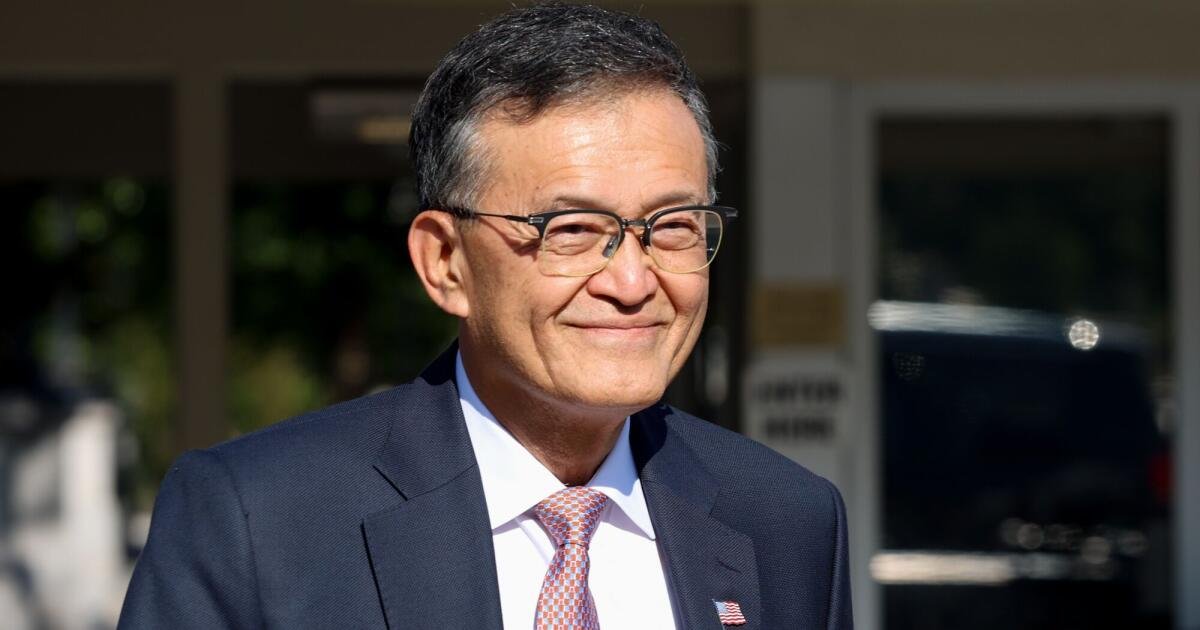
After Lip-Bu Tan became chief executive officer of Intel Corp. in March of last year, the struggling company’s shares went nowhere for seven months while the chipmaker was getting trounced in the market for artificial intelligence.
But after forging ties to the world’s biggest tech titans — and winning over President Trump — Tan is kicking off year two on a decidedly higher note. Apple Inc. and Tesla Inc. are showing interest in the company’s manufacturing. The processors it makes are back in demand, and budding optimism that Intel will finally start to benefit from the AI boom has sent its stock to a record.
Before Tan can deliver on shareholders’ rising expectations, he has to make changes within the 57-year-old company that was formerly a leader in semiconductor manufacturing. Since becoming CEO, Tan has spent far more time outside the company than inside, and has not widely explained his specific plan to fix products and manufacturing to employees, according to more than a dozen current and former staff, who were not authorized to speak publicly.
The fundamental issues remain, they said: Intel needs products that can win back lost share, and manufacturing that’s so good, even rivals will have to give it billions of dollars in orders. Neither of those is a given.
Tan, in his first interview as CEO, said he recognizes the company still has “a long way to go.”
“Intel has the technology, talent and scale to lead again, but leadership is earned through execution,” he said.
Tan acknowledged he has focused on customers, and said that he is now getting closer to the lineup of internal leadership he can trust to deliver. “I want to have a team that I can consider one team” with a “sense of urgency,” he said. He is targeting the end of June to complete his recruitment drive. This week, he made two hires.
While he builds his bench, Tan has been navigating some of Intel’s biggest problems by leaning on his network. In a key White House meeting last August, he turned a public blowup with Trump into a deal that made the U.S. government Intel’s third-largest shareholder. To arrange the change of heart, the CEO called upon his friends in the industry to vouch for him, including Michael Dell, according to people familiar with the matter.
More recently, Tan struck a partnership with Elon Musk on a scheme to build a massive factory complex and shake up the chip industry. The deal was the result of Tan chatting with Musk personally over time, and took most of the company’s other leaders by surprise, according to people familiar with the matter.
Tan, who has served on more than a dozen semiconductor boards and has personally invested in many more companies, had plenty of friends telling him not to take the Intel job, he said. The Silicon Valley pioneer was in turmoil, facing questions about whether it could even survive. It had allowed its once-leading manufacturing skills to atrophy. Its PC and server products, made with outdated production technology, lost market share. And it missed the biggest opportunity the semiconductor industry has seen in its history: Intel failed to develop an AI accelerator chip capable of competing with Nvidia Corp., and lost out on the beginnings of the AI boom.
Former business rivals, including Nvidia Chief Executive Officer Jensen Huang, have started talking about how central processing units, Intel’s main product, will play a major role in the artificial intelligence data center. But over the last decade, the capability of Intel’s factories has plummeted, to the point where it outsources manufacturing of some of its most important products to Taiwan Semiconductor Manufacturing Co. To prove reliability, the company needs to start meeting its timetables for introductions of new technology, said Naga Chandrasekaran, who has led Intel’s factory business for almost two years.
Chandrasekaran said one of his first goals is to win back his own product teams’ business, meaning they can stop outsourcing production. But even that won’t be enough. “Intel products alone, even in a wildly successful scenario, cannot fund the capital and filling the fabs and the scale that’s needed to be successful enough in a silicon business today,” he said.
He and Tan talk a lot about winning back Intel’s trust with customers. “He’ll sit in front of me, and he’ll tell me what the customer is telling him,’’ said Chandrasekaran, a former Micron Technology Inc. executive. “Ten pages worth of notes, and there’s no escaping.” Tan has prioritized telling prospective users of its plants that they’ll get at least equal treatment with Intel’s own product divisions, if not better.
Tan said he has plans for where he wants Intel to be in two years, five years and 10 years. “Credibility comes from results,’’ he said. But in internal communications, while not pulling punches about Intel’s performance, he relies on executives such as Chandrasekaran to come up with details of plans, employees said.
Those who know Tan or have worked for him said his management style mirrors his approach to venture capital investing. When he looks for someone to hire, he doesn’t want details and business plans, they said. Instead, he prefers a high-level conversation about the state of the industry. If they make a good impression, he backs them and devotes his energy to opening doors to help them to succeed, rather than scrutinizing their strategies or numbers, they said.
But in the chip industry, success and failure come in the details.
Chip factories that aren’t running flat out, or even as efficiently as they could, can be ruinous to own. According to New Street Research, Intel is struggling with as much as three times the cost per chip as industry leader TSMC. The biggest chunk of that — more than 40% — is tied to yield, the number of good chips it gets per production run. Intel’s yield rate is about 65%, compared with more than 80% at the Taiwanese company. Only 8% of the difference in those costs is accounted for by the relatively more expensive price of labor in the U.S.
Even if Intel’s rivals decide to trust him, the brutal economics of the chip industry mean that they are reluctant to spend the money it takes to switch, even partially, to a new supplier. They need proof it will pay off immediately, and no one wants to go first, according to Daiwa Capital Markets analyst Louis Miscioscia.
“You want another company to be the one that partners with Intel and takes the pain,’’ he said.
Some at Intel still believe the company should be broken up, to split manufacturing and product design and accelerate progress. Tan said that can’t happen anytime soon and that there are advantages to keeping the two units tied together. Over time, he could see an arrangement along the lines of EMC Corp.’s former operation of VMware as a majority-owned subsidiary.
For now, Tan will need to instill momentum at the company. As former CEO Pat Gelsinger put it: Intel, which once had 99% share of data center processors, was built to lead, not to compete.
Kevork Kechichian, whom Tan brought in to run the company’s crucial server chip unit, said that when he speaks with some teams that have fallen behind on a deadline by a couple of weeks, he gets a response that he has not heard at Qualcomm Inc., Arm Holdings Plc or other companies he’s worked at.
“I said, ‘What’s the recovery?’ and they came back with, the recovery is they adjusted the schedule to go another two weeks,” he said.
Getting at least 80% of the organization to believe in the need for urgency and commit to it is one of the management team’s priorities, Kechichian said.
Under previous leadership, Intel’s numbers — three years of losses and revenue down 33% from a 2021 peak — were not painted as dire, according to Chandrasekaran.
Investors, who had bid up Intel’s stock following the cash injections last year, were reminded in January that Tan’s rescue project still has a way to go. The company’s financial performance fell short of projections partly because it hadn’t allocated enough production to cover resurgent demand for data center chips and partly because its latest production, called 18A, isn’t producing as many usable semiconductors as the company would like. Since then, Intel’s made improvements, but it’s still not on par with industry leaders.
“I’m disappointed that we are not able to fully meet the demand in our markets,” Tan said at the time. “My team and I are working tirelessly to drive efficiency and more output from our fabs,” or semiconductor fabrication plants. “While yields are in line with our internal plans, they are still below what I want them to be.” Since then, he’s said factories are rapidly improving and outside interest in using Intel is growing.
As much as semiconductors are ruled by cutting-edge science and difficult economics, momentum counts. For more than 30 years, Intel set the agenda. Its developer conference in San Francisco was the annual reveal of technology that the rest of the computing industry based its products and plans around. An attempt to revive it under Tan’s predecessor was scrapped to save money.
Now that mantle has been grabbed by Nvidia’s leader, Huang, and his conference, GTC, sets the direction for artificial intelligence computing. The conference sparked hope for Intel — not because of any great technical progress, but because Huang spoke about future exploding demand for CPUs.
That’s good for Intel, but only if Tan can act fast, while rivals continue to erode his market share.
“As much as I believe in Lip-Bu, I think he was dealt such a difficult hand,” said Jon Bathgate, a fund manager at NZS Capital. “I think he’s got as good a shot as anyone has of making it work.”
King writes for Bloomberg.
Leave a Reply