
Now Reading: Kings of the hill: DII baseball impact pitchers
- 01
Kings of the hill: DII baseball impact pitchers

Kings of the hill: DII baseball impact pitchers
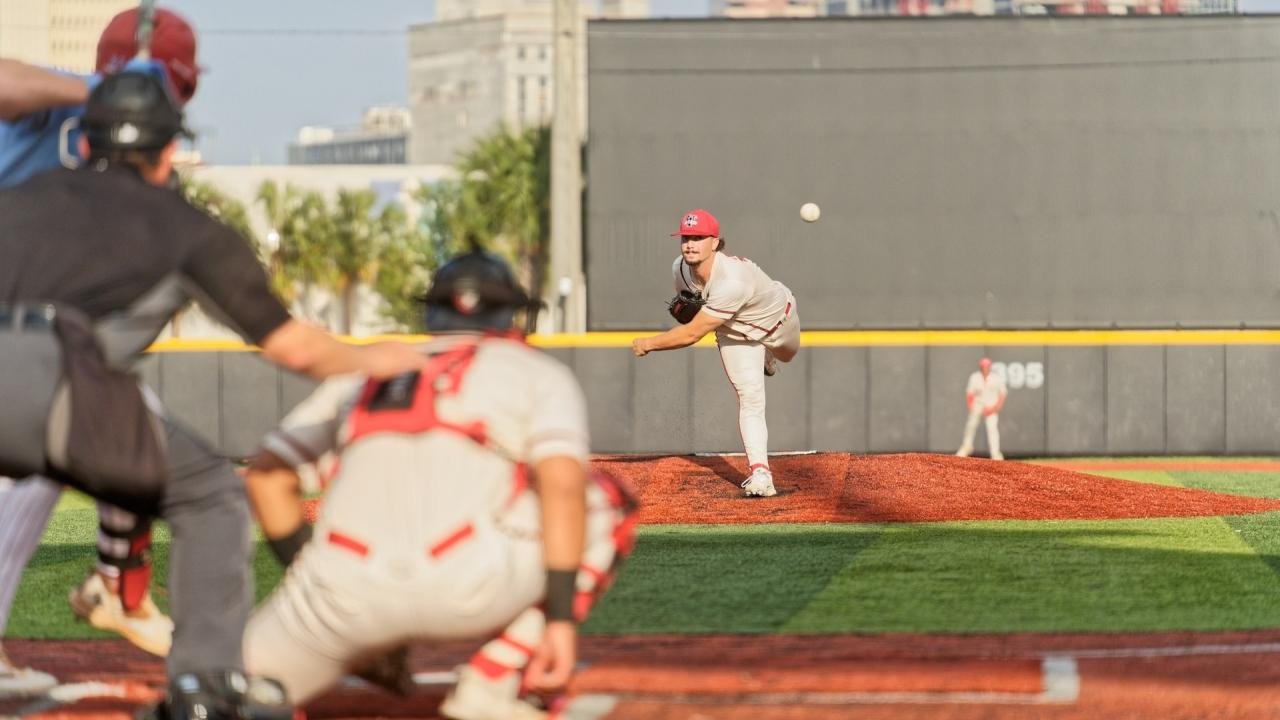
Dudes. Aces. Fireballer. Stud. Whatever you choose to call a team’s star pitcher, DII baseball is loaded with them in 2026. Perhaps to no one’s surprise, many of the best pitchers are on rotations that are leading their teams to the DII baseball championship.
RANKINGS: The latest Power 10 | The field of 56, projected
As the regular season winds down and conference tournaments begin, let’s take a look at some of the best arms DII has to offer.
DII baseball’s kings of the hill

Robert Satin
The Tampa one-two punch. It almost isn’t fair to DII that the Spartans, who are chasing their first three-peat in an illustrious program history, may be better on the mound than last year. That is because they have a pair of No. 1s in lefties Robert Satin and B.J. Bailey. Both Bailey and Satin are in the top five of ERA in DII and both are also in the top 10 in WHIP.
Bailey, the DII Report’s preseason SSC newcomer of the year, transferred in from Clemson and has pitched to an 11-0 record with a 1.38 ERA and 0.99 WHIP with 78 strikeouts and 21 walks across 78 innings. He has a three-pitch mix highlighted by a fastball that sits 88-91, curveball, and changeup, and per Sam Militello, Tampa’s longtime pitching coach, has been able to throw any pitch in any count. “B.J.’s confidence to execute any pitch at any time is what has been impressive,” Militello added. “He attacks hitters and has been able to make big pitches in big situations.”
Satin was on the national championship Spartans a year ago but is hardly the pitcher he was last year. He spent time in the bullpen and rotation last year, with modest numbers. This year, he has exploded, sitting at 9-2 with a 1.67 ERA, a 0.88 WHIP and 89 strikeouts to just 10 walks over 89 innings pitched. He throws a fastball, cutter and changeup, and has been able to command the ball to both sides of the plate. “I believe last year’s innings allowed him to learn a lot, especially after not pitching much his freshman year at [Florida],” Militello said. “It taught him how to compete and make adjustments, and he has done that all year for us.
“I think what has made both these guys successful is the ability to throw the ball over the plate. They have limited their walks, which has allowed them to pitch deeper into games.”

Corbin Talley, Northwest Nazarene. Talley, a Northwestern State bullpen transfer, stepped into a Nighthawks’ rotation that was left barren after last year’s big run to Cary. Thus far, he has fit the bill, becoming a true ace and one of the best pitchers in the West Region, and all DII. A tall, lanky left-hander, head coach Joe Schaefer told NCAA.com that he typically pitches in the 86-88 mph range and can get up to 90. He’s currently 9-0 with a 1.76 ERA, a 1.19 WHIP and 82 strikeouts in 61.1 innings pitched, some of the best numbers across the board in the entire division.
“He gets good run on the fastball, with an average 16-inch horizontal break,” Schaefer said. “He commands it pretty well and also throws a 75-mph curveball and 80-mph changeup. He has been more efficient over the last month than when he started the season and has been able to go deeper into games as his command has improved.” To Schaefer’s point, Talley has gone at least six innings in each of his last five starts, allowing just four earned runs while striking out 34.

Colby Deaver.
Colby Deaver, Emporia State. The Hornets will be battling for their DII tournament lives down the stretch, and lucky for them, they have a dude atop the rotation to lead the way. Deaver is a sophomore transfer from MIAA-foe Missouri Western, where he struggled keeping runners from scoring as a freshman. In his big breakout campaign for Emporia State, the righty is among DII’s top 10, sitting at 9-2 with a 1.35 ERA, and 0.84 WHIP, a microscopic .195 batting average against and 78 strikeouts with just 10 walks in 80.0 innings pitched. He’s armed with an 89-91 mph sinker that tops out at 93, a slider in the low 80s, and a changeup that sits 78-80. For Anthony Caenepeel, the Hornets’ pitching coach, Deaver’s “command and control grade is an A+ for college, but on the scouting scale maybe 70 (80 is the top, and most rare, grade on the scouting scale).
“Colby competes at an extremely high level on every pitch of the game,” Caenepeel added. “His ability to command three pitches in any count and pitch to both sides of the plate allow him to be unpredictable multiple times through the order. He is always on the attack and wants the ball in the biggest moments.”

Evan Koehler
Evan Koehler, Georgia Southwestern. If strikeouts are your thing, look no further than the current King of the K. The 6-foot-2 righty not only leads DII by 20 strikeouts, his 114 are second-most in all NCAA baseball. He has a big fastball that has been up to 93, a curveball that sits in the low 80s and adds in a 79-82-mph change, and his command and control are sharp — his 6.41 strikeout-to-walk ratio is top five in DII. As his head coach Josh McDonald pointed out, the situation or opponent doesn’t affect the moment for Koehler. His two best outings this season were an eight-inning, one-run, 11-strikeout masterpiece against North Greenville’s monster lineup and a complete game, 15-strikeout victory against Tampa, where he outdueled Robert Satin in one of the premier showdowns of aces this season.
Koehler was well-traveled before landing with the Hurricanes. He started at Polk State and then stopped at South Florida before transferring to Georgia Southwestern. Jordan Barrett, the current Hurricane pitching coach, worked with Koehler at Polk, so when they saw him in the portal, they knew they were getting a gem. “Evan has been a tremendous work horse for us this year,” McDonald said. “He is consistent each week in his preparation and gives us a great chance to win every time he’s on the mound. Hopefully we can continue this run through the postseason, and he definitely should get an opportunity to pitch at the next level.”

Adrian Byrd.
Adrian Byrd, Delta State. Byrd, a 6-foot lefty, is one of the bigger breakouts of the 2026 season. Last year, appearing primarily in relief, he pitched to a 16.62 ERA and 3.69 WHIP, which makes his transformation into a top-of-the-rotation (TOR) arm fascinating. He is currently 7-1 with a 1.64 ERA and 0.99 WHIP with 91 strikeouts in 77 innings pitched, all of which are top 10 marks in DII. He has a three-pitch arsenal, all of which he commands in the zone, highlighted by an 88-92 mph fastball to go with a slider and changeup.
“Adrian has been a different pitcher for us this year as opposed to last year,” head coach Rodney Batts told me. “He has pitched with confidence with all three pitches. He has the ability to throw any pitch in any count. He has commanded the zone and been able to pitch on both sides of the plate. The main thing he has concerned himself with is not walking guys and challenging the hitters.”

Julian Costa
Julian Costa, West Chester. If you pitch a no-hitter in consecutive seasons, you are on another level. If you are the TOR for the No. 1 team in the Atlantic Region and No. 1 overall KPI in DII, you certainly get an invite to this list. Costa checks both those boxes for the Golden Rams, currently sitting at 8-2 with a 2.24 ERA, 1.06 WHIP, a .233 batting average against, and a fraction under a strikeout per inning pitched. The no-hitter he threw this season was against Frostburg State, the best team in the MEC and lining up to be an adversary in the Atlantic bracket.
Costa has a three-pitch mix with an 88-90 mph fastball, a curveball that sits in the mid-70s and a changeup. Head coach Mike LaRosa gives him a 70 grade on command, with the ability to move all his pitches around the strike zone. “Julian induces weak contact early in counts that allows him to go deep into games,” LaRosa added. “Four of his 10 starts have been complete games, including three complete-game shutouts. Aside from his overall stuff, what makes Julian great is his competitiveness and poise on the mound. He truly is unfazed by results, regardless of good or bad, and just goes out and competes at a high level on every single pitch. And the bigger the moment, the better he gets. He is the most consistent pitcher I have ever coached as far as preparation and demeanor on the mound.”

Collin Bradley.
Collin Bradley, Grand Valley State. The Lakers have a three-headed monster in their weekend rotation that has them the best in the Midwest. Owen Avery and Jackson Kees are very good, and will make the Lakers hard to eliminate in tournament-style play, but it is Bradley that sets the tone, leading the GLIAC with a 1.83 ERA with the conference’s second-lowest batting average against (.203) and a 0.92 WHIP that is top five in DII. All that has led to a perfect 8-0 record for a Lakers team looking to make history.
Bradley has a four-pitch arsenal featuring a high 80s fastball with a lot of movement, a mid 70s curveball, and 80-mph splitter he attacks both righties and lefties with, and a high 70s slider that, according to head coach Jordan Keur, has been one of his best pitches with a lot of horizontal movement. “Collin’s control and command have been exceptional all year,” Keur added, “which is evident by only issuing 13 walks over 68.2 innings pitched, a testament to his consistency on the mound. What truly sets him apart is his ability to throw all of his pitches for strikes, and the ability to mix speeds and locations. He’s got complete confidence in his arsenal and has that comfortability factor to throw any pitch in any count.”
The arms race: More impact arms to watch down the stretch
Ashland is a DII tournament staple but is battling to stay in the mix. No. 1 Drew Becker will have to be big in the G-MAC tournament. The redshirt-sophomore righty is having his best year, now completely shifted to a full-time starter, with a 6-1 record and a 2.97 ERA, 1.01 WHIP and 87 strikeouts to just 17 walks in 63.2 innings pitched.
North Greenville has been No. 1 in the DII baseball Power 10 for several weeks now, and while they are led by one of the most dynamic lineups in DII, having Matty Brown and Bennett Roemer
Of course, no DII baseball list is complete without the Griffins or Mules. This year it is Sawyer Allen leading the way for Central Missouri, sitting at 6-1 with a 2.44 ERA and 0.92 WHIP with more than a strikeout per inning and a .194 batting average against.
Per usual, Seton Hill has not one, but two pitchers leading the charge. Last year, it was Ian Korn and Jon McCollough and this year, Sean Williams and Mark Wechtenhiser are helping Seton Hill challenge for the No. 1 seed in the Atlantic Region. Williams has a 9-1 record with a 2.47 ERA, 1.04 WHIP and .203 batting average against, throwing a no-hitter earlier this month. Wechtenhiser is 7-1 with a 2.47 ERA, 0.95 WHIP and team-high 57 strikeouts. Throw in 6-1 Luke Deschenes, and the PSAC tournament is going to have some elite pitching duels.